Vesicle (Latin: vesicula)
Also called the cytoplasmic vesicle
Overview
of the
cell
- Cell membrane : phospholipid bilayer, membrane proteins, sugar chains
- Cytoplasm
- Cytosol : water, electrolytes, metabolic enzymes, free amino acids, metabolic intermediates
- Organelles : mitochondria, endoplasmic reticulum, centrosome, Golgi apparatus, lysosomes, peroxisomes, vesicles (some sources do not count vesicles as organelles)
- Cytoskeleton : microtubules, actin filaments, intermediate filaments
- Nucleus : nuclear envelope, nucleoplasm, chromatin, nucleolus; the nucleus is also counted among the organelles
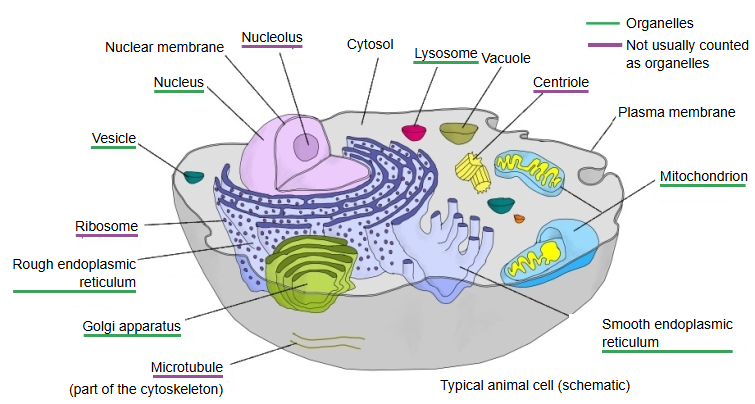
Table of organelles
| Organelles (cell organelles) | ||
|---|---|---|
| 1 | Nucleus | Storage of DNA, control of transcription |
| 2 | Mitochondria | ATP production, energy metabolism |
| 3 | Rough endoplasmic reticulum | (RER) Synthesis of proteins for secretion and of membrane proteins |
| 4 | Smooth endoplasmic reticulum | (SER) Lipid synthesis, storage of Ca2+, detoxification |
| 5 | Golgi apparatus | Modification, sorting and transport of proteins |
| 6 | Lysosome | Breakdown and recycling |
| 7 | Peroxisome | Oxidation reactions (hydrogen peroxide), fatty-acid metabolism |
| 8 | Endosome | Endocytic pathway |
| 9 | Vesicle | Transport of substances, including their release from the cell |
| Not usually counted as organelles (no membrane) | ||
| 1 | Ribosome | Protein synthesis |
| 2 | Cytoskeleton | Keeping the shape of the cell, transport |
| 3 | Centrosome (centrioles) | Formation of the spindle |
| 4 | Nucleolus | Synthesis of rRNA, assembly of ribosomes |
Types and roles
Vesicles can be divided into four broad groups.
of
vesicles
- Transport vesicles : carry substances between organelles
- Secretory vesicles : release substances out of the cell
- Endocytic vesicles : take in material from outside the cell and sort it
- Degradation and recycling : break down unwanted material, foreign matter and the cell's own components
Transport vesicles
Transport vesicles are membrane vesicles that enclose proteins and lipids inside the cell and carry them selectively between particular organelles. They bud off one membrane and fuse with another.
The table lists transport vesicles by route.
The tables in this section give typical examples and may not be complete.
| Vesicle | Route | Main role | |
|---|---|---|---|
| 1 | COPII-coated vesicle | Endoplasmic reticulum (ER) → Golgi apparatus | Forward transport of newly made proteins |
| 2 | COPI-coated vesicle | Golgi apparatus → ER (and between Golgi cisternae) | Backward transport, return of ER components |
| 3 | Clathrin-coated vesicle (from the trans-Golgi network) | Golgi apparatus → endosomes | Transport to the lysosome system |
| 4 | Intra-Golgi transport vesicle | Within the Golgi apparatus | Transport between the cis and trans sides |
| 5 | ER exit-site vesicle | Next to the ER | Starting point of transport |
Secretory vesicles
Secretory vesicles are vesicles whose final purpose is to fuse with the cell membrane and release their contents outside the cell (exocytosis). They are especially numerous in glandular cells.
The table lists examples of secretory vesicles.
Constitutive secretion goes on all the time in most cells; in regulated secretion the vesicles or granules are stored until a signal arrives.
| Vesicle | Main cells | Main role | |
|---|---|---|---|
| 1 | Constitutive secretory vesicle | Most cells | Steady release of membrane proteins and secreted proteins |
| 2 | Regulated secretory vesicle | Endocrine and exocrine cells, neurons and others | Release on a signal, for example of hormones |
| 3 | Synaptic vesicle | Neurons | Storage and release of neurotransmitters |
| 4 | Neurosecretory granule | Neurosecretory cells | Secretion of peptide hormones |
| 5 | Secretory granule (zymogen granule) | Exocrine cells such as acinar cells | Secretion of digestive enzymes and others |
Endocytic vesicles
Endocytic vesicles take material from outside the cell, together with parts of the cell membrane, into the cell (endocytosis) and carry it to endosomes and lysosomes.
The table lists examples of endocytic vesicles.
| Vesicle | Where it forms | Main role | |
|---|---|---|---|
| 1 | Clathrin-coated vesicle (from the cell membrane) | Cell membrane | Receptor-mediated endocytosis |
| 2 | Early endosome | Outer part of the cytoplasm | Sorting of the material taken in |
| 3 | Late endosome | Deeper in the cytoplasm | Transport to the lysosome |
| 4 | Recycling vesicle | Endosome | Return of receptors and membrane to the surface |
| 5 | Caveolar vesicle (caveola) | Cell membrane | Uptake of particular molecules (in some cell types); small flask-shaped pits |
Degradation and recycling
Vesicles of the degradation and recycling group break down material taken into the cell and cell components that are no longer needed, so that the products can be used again.
The table lists examples of these vesicles.
| Vesicle | Main role | Notes | |
|---|---|---|---|
| 1 | Phagosome | Uptake of bacteria and foreign particles | In macrophages and others |
| 2 | Autophagosome | Encloses the cell's own worn-out parts | Double membrane |
| 3 | Lysosome | Digestion inside the cell | Acidic inside, full of digestive enzymes |
| 4 | Autolysosome | Breakdown of the cell's own components | Autophagosome + lysosome |
| 5 | Multivesicular body (MVB) | Formation of exosomes | An endosome with small vesicles inside; it is either digested or releases them as exosomes |
Questions and answers
Q: What is the energy source for moving vesicles through the cell?
A: The main source is ATP. More precisely, vesicles are carried by motor proteins that use ATP as fuel and move along the cytoskeleton.
Key points of the mechanism
Rails:
Microtubules (mostly long-distance transport)
Actin filaments (near the cell membrane)
Motor proteins (ATP-dependent):
Kinesin: moves towards the plus end of microtubules
Dynein: moves towards the minus end of microtubules
Myosin: moves along actin filaments
Budding of vesicles, formation of their coats and fusion of membranes also use energy (ATP and GTP).
But the force for the movement itself comes directly from motor proteins driven by the breakdown of ATP.
In short, vesicles move because motor proteins fuelled by ATP run along the cytoskeleton.
Q: Are vesicles scattered at random in the cytoplasm?
A: No, they are not random.
Vesicles do not drift aimlessly in the cytoplasm: each has a starting point and a destination, and they are placed and moved in a set direction along the cytoskeleton.
Starting point and destination are fixed (the endoplasmic reticulum, Golgi apparatus, endosomes, cell membrane and others).
The cytoskeleton is the rail: they move along microtubules and actin filaments.
Motor proteins pull them: kinesin, dynein and myosin (ATP-dependent).
The fusion partner is strictly specified: recognition by Rab proteins and SNARE proteins makes sure each vesicle fuses with the right target.
Even vesicles that are not moving lie mostly near their starting point or destination.
They are hardly ever left to simple diffusion.
In short, vesicles lie in the cytoplasm, but not at random: their positions and routes are tightly controlled.
Related terms
References and sources
- Further reading: Vesicle (biology and chemistry), Wikipedia.
- Federative International Programme for Anatomical Terminology (FIPAT). Terminologia Anatomica, 2nd ed. (TA2), 2019.