Golgi apparatus (Latin: complexus golgiensis)
Also called: Golgi body, Golgi complex
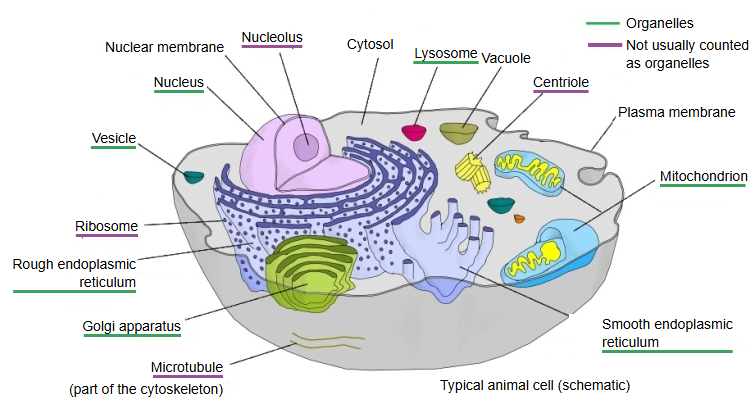
The Golgi apparatus is one of the structures inside each cell of our body (the organelles). It processes (changes and modifies) the proteins of the cell and is responsible for transporting them. It is also called the Golgi body or Golgi complex.
of the
cell
- Cell membrane : phospholipid bilayer, membrane proteins, sugar chains
- Cytoplasm
- Cytosol : water, electrolytes, metabolic enzymes, free amino acids, metabolic intermediates
- Organelles : mitochondria, endoplasmic reticulum, centrosome, Golgi apparatus, lysosomes, peroxisomes, vesicles (some sources do not count vesicles as organelles)
- Cytoskeleton : microtubules, actin filaments, intermediate filaments
- Nucleus : nuclear envelope, nucleoplasm, chromatin, nucleolus; the nucleus is also counted among the organelles
More detail
Form
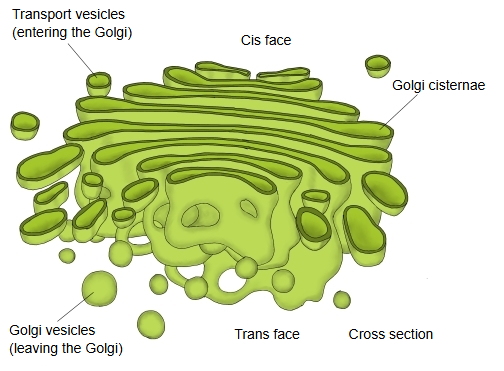
It is a stack of flattened, hollow, disc-shaped sacs about 0.5 µm across, the Golgi cisternae; a stack usually has four to eight of them, and in some cells many more. The cisternae lie close together, separated by narrow gaps, and are surrounded by small vesicles.
(1 µm, one micrometre, is one thousandth of a millimetre.)
Number
A mammalian cell typically contains about 40 to 100 Golgi stacks, which are usually linked into a ribbon near the nucleus. The stacks are not fixed structures: they seem to form and disappear again and again.
Live imaging of single cisternae (in yeast) has shown how this happens: a cisterna first carries the enzymes of the cis side, then medial and trans enzymes are added, until it carries only trans enzymes and finally breaks up into vesicles (cisternal maturation). Other organelles have also been reported to form and disappear in a similar way.
Location
It lies close to the endoplasmic reticulum, usually near the nucleus and the centrosome.
Names of the parts
Several sources were consulted; the names below differ from source to source.
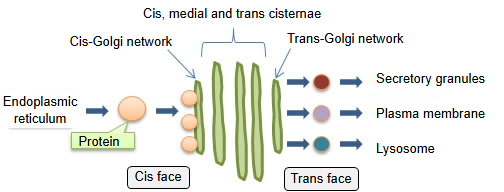
| 1 | Cis-Golgi network | the network-like Golgi cisterna on the cis (entry) side, facing the endoplasmic reticulum |
| 2 | Trans-Golgi network | the network-like Golgi cisterna on the trans (exit) side, where products are sorted |
| 3 | Golgi stack (Golgi lamellae) | the stacked part of the Golgi apparatus between the cis-Golgi network and the trans-Golgi network |
| 4 | Cis cisterna | the Golgi cisterna of the stack on the cis side |
| 5 | Medial cisterna | the Golgi cisternae in the middle of the stack |
| 6 | Trans cisterna | the Golgi cisterna of the stack on the trans side |
| 7 | Golgi vesicle | a vesicle leaving the Golgi apparatus whose contents have undergone chemical modification, such as the addition of sugar chains |
Function
Summary
Reference websites
[Wikipedia]
· Golgi apparatus, Wikipedia.
[Websites with illustrations]
· Golgi body (glossary with illustration) (National Human Genome Research Institute)
· Diagram of a Golgi stack (Wikimedia Commons)

· Human leukocyte showing the Golgi apparatus (electron micrograph) (Wikimedia Commons)

Related terms
- Cytoplasm
- Endoplasmic reticulum
- Ribosome
- Organelle
- Cell nucleus
- Secretory cell
- Glandular cell
- Exocrine cell
- Plasma cell
References and sources
- Further reading: Golgi apparatus, Wikipedia.
- Federative International Programme for Anatomical Terminology (FIPAT). Terminologia Anatomica, 2nd ed. (TA2), 2019.