Peroxisome (Latin: peroxisoma)
Also called the microbody
The peroxisome is one of the organelles; it takes part in lipid metabolism and in the breakdown of harmful substances.
Organelle: a structure in the cytoplasm, enclosed by a membrane, that has a particular job
It has a single membrane and is almost round; its size is about 0.1–1.0 µm, and the number per cell varies greatly from cell to cell.
sometimes oval
Single membrane: in human cells the peroxisome, the endoplasmic reticulum, the Golgi apparatus and the other organelles have a single membrane; only the nucleus and the mitochondria have a double membrane.
Number per cell: a few to a dozen or so where they are few, tens to hundreds where they are many; for liver cells 100–1,000 per cell has been reported. They are also numerous in kidney cells.
The peroxisome contains about 40–60 kinds of enzymes, and the kinds of enzymes decide what it does.
All of them are made on free ribosomes in the cytosol and then imported into the peroxisome
Enzymes and their functions (examples)
| Function | Enzymes | Notes | |
|---|---|---|---|
| 1 | β-oxidation of fatty acids | · acyl-CoA oxidase · multifunctional enzymes · thiolase | · β-oxidation of very-long-chain fatty acids · these are hard for the mitochondria to handle |
| 2 | Hydrogen peroxide metabolism | · various oxidases · catalase | · production and breakdown of hydrogen peroxide (H2O2) |
| 3 | Detoxification (liver cells) | · catalase · various oxidases | · detoxification of harmful substances such as methanol, formaldehyde and part of the ethanol |
| 4 | Bile acid synthesis | · D-bifunctional protein · peroxisomal thiolase | · shortening of the side chain of bile acids · directly linked to digestion; the mitochondria cannot take over |
| 5 | Amino acid metabolism | · D-amino acid oxidase · L-pipecolic acid oxidase | · metabolism of special amino acids · important only in certain cells and conditions; without these enzymes the function does not exist |
Structure
of the
cell
of the
cell
- Cell membrane : phospholipid bilayer, membrane proteins, sugar chains
- Cytoplasm
- Cytosol : water, electrolytes, metabolic enzymes, free amino acids, metabolic intermediates
- Organelles : mitochondria, endoplasmic reticulum, centrosome, Golgi apparatus, lysosomes, peroxisomes, vesicles (some sources do not count vesicles as organelles)
- Cytoskeleton : microtubules, actin filaments, intermediate filaments
- Nucleus : nuclear envelope, nucleoplasm, chromatin, nucleolus; the nucleus is also counted among the organelles
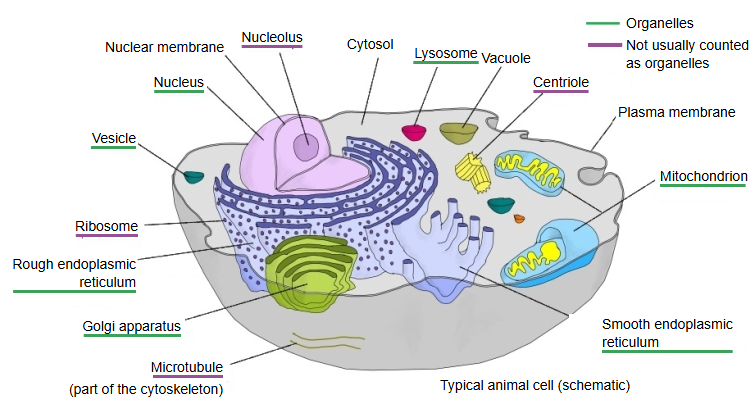
Table of organelles
| Organelles (cell organelles) | ||
|---|---|---|
| 1 | Nucleus | Storage of DNA, control of transcription |
| 2 | Mitochondria | ATP production, energy metabolism |
| 3 | Rough endoplasmic reticulum | (RER) Synthesis of proteins for secretion and of membrane proteins |
| 4 | Smooth endoplasmic reticulum | (SER) Lipid synthesis, storage of Ca2+, detoxification |
| 5 | Golgi apparatus | Modification, sorting and transport of proteins |
| 6 | Lysosome | Breakdown and recycling |
| 7 | Peroxisome | Oxidation reactions (hydrogen peroxide), fatty-acid metabolism |
| 8 | Endosome | Endocytic pathway |
| 9 | Vesicle | Transport of substances, including their release from the cell |
| Not usually counted as organelles (no membrane) | ||
| 1 | Ribosome | Protein synthesis |
| 2 | Cytoskeleton | Keeping the shape of the cell, transport |
| 3 | Centrosome (centrioles) | Formation of the spindle |
| 4 | Nucleolus | Synthesis of rRNA, assembly of ribosomes |
Related terms
References and sources
- Further reading: Peroxisome, Wikipedia.
- Federative International Programme for Anatomical Terminology (FIPAT). Terminologia Anatomica, 2nd ed. (TA2), 2019.