Intermuscular septum (Latin: septum intermusculare)
Also called the intermuscular septa (plural)
In the arm, the thigh and the leg, an intermuscular septum is a sheet of dense connective tissue that passes inward from the outermost deep fascia of the limb and attaches to the bone, dividing the muscles of that part into several groups (compartments). Each septum runs from the deep fascia to a line or border on the long bone.
Each compartment holds a group of muscles with a similar action and, usually, a shared nerve supply. Because the compartments are closed, swelling inside one can raise the pressure and squeeze its vessels and nerves (compartment syndrome).
The main intermuscular septa are listed below.
| Region | Name | Remarks | |
| Arm | 1 | Medial intermuscular septum of arm (intermuscular septa of arm) | From the brachial fascia to the medial supracondylar ridge of the humerus. |
| 2 | Lateral intermuscular septum of arm (intermuscular septa of arm) | From the brachial fascia to the lateral supracondylar ridge of the humerus. The two septa separate the anterior (flexor) from the posterior (extensor) compartment. | |
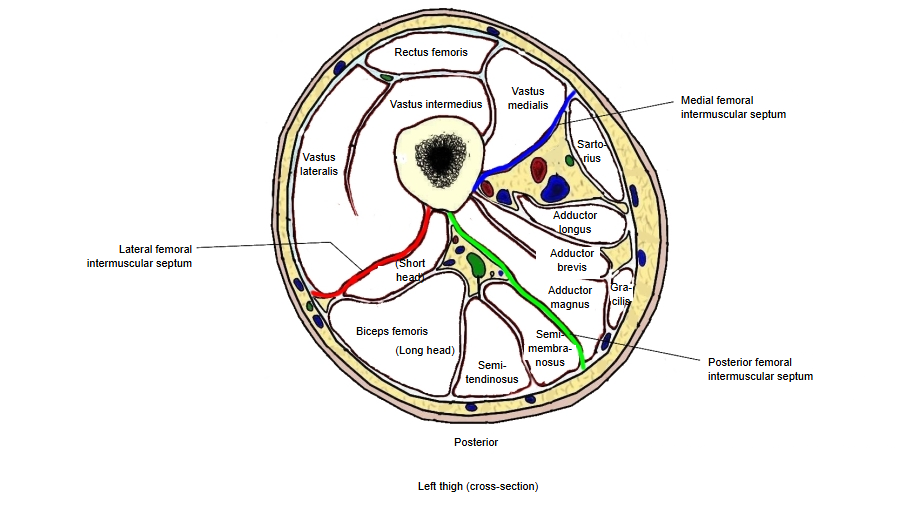
| Thigh | 1 | Medial femoral intermuscular septum (femoral intermuscular septa) | Attached to the medial lip of the linea aspera of the femur. |
| 2 | Lateral femoral intermuscular septum (femoral intermuscular septa) | Attached to the lateral lip of the linea aspera. | |
| 3 | Posterior femoral intermuscular septum | A thin sheet between the adductors and the hamstrings, added by many texts; it is not a standard term and is missing from some sources. | |
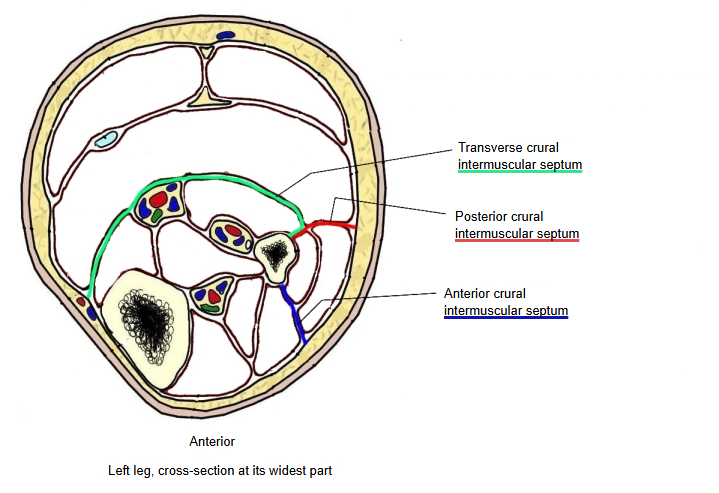
| Leg | 1 | Anterior crural intermuscular septum | To the anterior border of the fibula. |
| 2 | Posterior crural intermuscular septum | To the posterior border of the fibula. With the anterior septum it encloses the lateral (fibular) compartment. | |
| 3 | Transverse crural intermuscular septum (crural intermuscular septa) | The deep transverse fascia of the leg, between the superficial and deep parts of the posterior compartment; sources differ on whether to call it an intermuscular septum. |
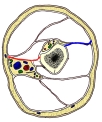 Right arm (cross-section)
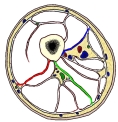 Left thigh (cross-section)
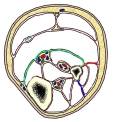 Left leg (cross-section)
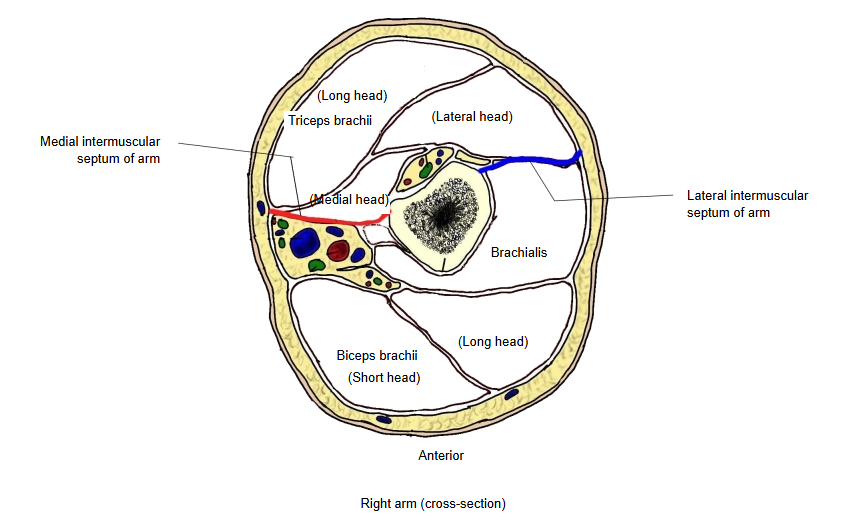
For example, the medial and lateral intermuscular septa of the arm (intermuscular septa of arm) give origin to part of the triceps brachii (its medial head); fibres of the brachialis also arise from them. Septa generally give origin to muscle fibres on both sides.
Related terms
- Fascia
- Medial and lateral intermuscular septa of arm
- Femoral intermuscular septa
- Crural intermuscular septa
- Medial intermuscular septum
- Lateral intermuscular septum
- Posterior femoral intermuscular septum
References and sources
- Further reading: Fascial compartment, Wikipedia.
- Further reading: Intermuscular septum, Wikipedia.
- Federative International Programme for Anatomical Terminology (FIPAT). Terminologia Anatomica, 2nd ed. (TA2), 2019.