Mastoid notch (Latin: incisura mastoidea)
Also called Digastric groove or the digastric notch
- Squamous part : occupies the middle and the whole upper part; it has a temporal (outer) surface and a cerebral (inner) surface.
- Petrous part
- Mastoid part : lies below and behind the squamous part (towards the parietal notch). Related terms: mastoid process, mastoid notch, groove for the occipital artery, groove for the sigmoid sinus, mastoid foramen, mastoid air cells, mastoid canaliculus, canaliculus for the chorda tympani, tympanomastoid fissure.
- Pyramid : a three-sided pyramid that runs forwards and medially from the boundary between the squamous and mastoid parts; the petrous part in the narrow sense.
- Tympanic part : the smallest part: a curved plate of bone that forms the front and lower walls of the external acoustic meatus.
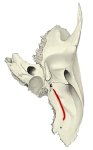 Temporal bone (inferior view)
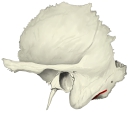 Temporal bone (lateral view)
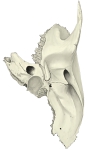 Temporal bone (inferior view), labelled
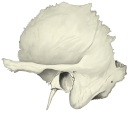 Temporal bone (lateral view), labelled
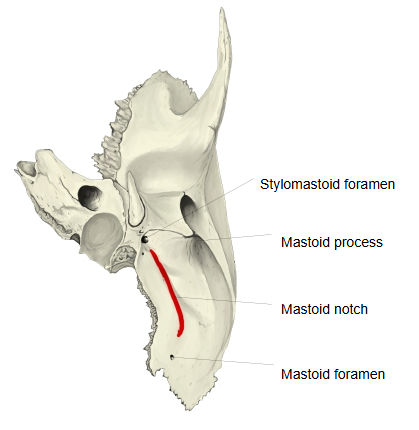
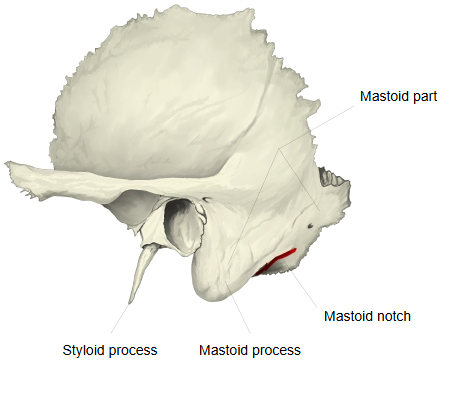
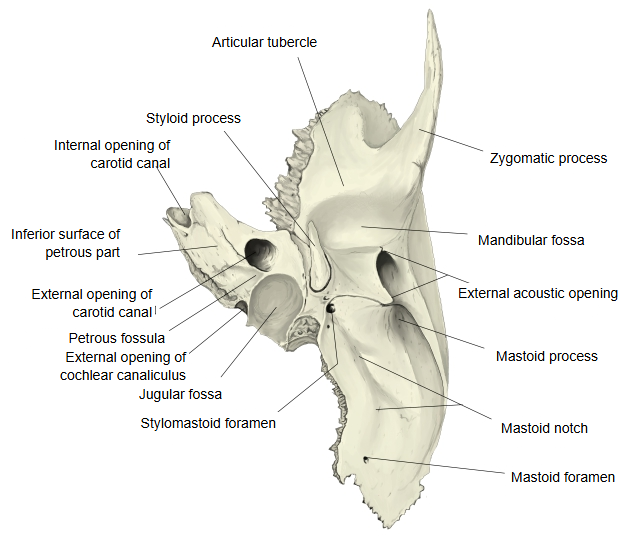
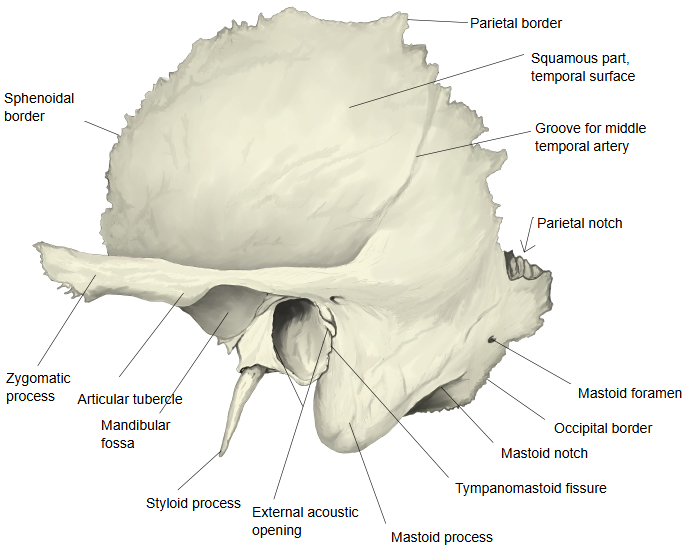
On the medial side of the mastoid process lies a deep groove, the mastoid notch (also called the digastric groove or digastric notch; not to be confused with the digastric fossa of the mandible), from which the posterior belly of the digastric arises. Medial to it runs the groove for the occipital artery, and its front end lies just behind the stylomastoid foramen.
Reference websites
[Wikipedia]
· Mastoid notch, Wikipedia.
· Temporal bone, Wikipedia.
[Websites with illustrations]
· Mastoid notch (IMAIOS e-Anatomy)
· Mastoid notch of the temporal bone, close-up (inferior view) (Wikimedia Commons)

· Base of the skull, external surface (Gray's Anatomy, fig. 187) (Wikimedia Commons)

Related terms
- Mastoid part of temporal bone
- Mastoid process
- Groove for occipital artery
- Stylomastoid foramen
- Tympanomastoid fissure
- Mastoid cells
- Digastric
- Temporal bone
References and sources
- Further reading: Mastoid notch, Wikipedia.
- Further reading: Temporal bone, Wikipedia.
- Federative International Programme for Anatomical Terminology (FIPAT). Terminologia Anatomica, 2nd ed. (TA2), 2019.