Orbital surface of maxilla (Latin: facies orbitalis maxillae)
The orbital surface of the maxilla is one of the four surfaces of the body of the maxilla: the upper surface, which forms part of the floor of the orbit.
Body of the maxilla: the main part of the maxilla, without its processesFloor of the orbit: formed by the maxilla, the zygomatic bone (orbital surface) and the palatine bone (orbital process)
Maxilla
- Body : the main part of the maxilla without its four processes; it has four surfaces:
• Anterior surface: part of the face
• Infratemporal surface: behind the zygomatic process (also called the posterior surface)
• Orbital surface: the upper surface, facing the orbit and forming part of its floor
• Nasal surface: forms part of the lateral wall of the nasal cavity (= medial surface) - Processes : frontal process, zygomatic process, palatine process and alveolar process.
Features of the orbital surface
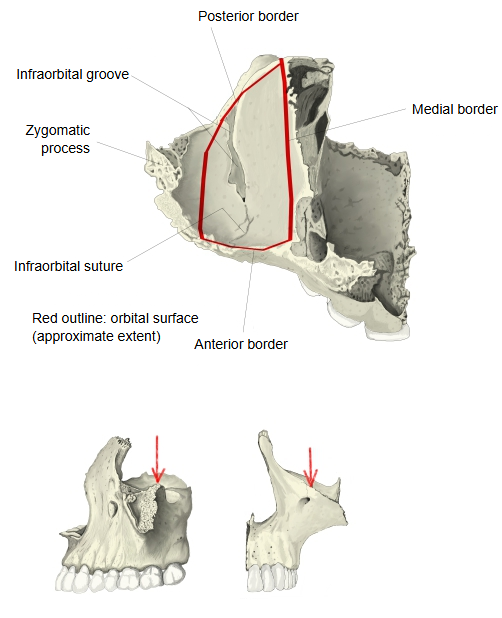
The infraorbital groove begins near the middle of the posterior border of the orbital surface and runs obliquely forwards, then continues as the infraorbital canal; the anterior border of the surface forms part of the infraorbital margin. From the front end of the groove the infraorbital suture runs towards the infraorbital foramen on the anterior surface of the body of the maxilla. It is a trace of fusion during development, often described as the line where the body and the zygomatic process fused (sources differ).
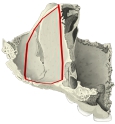 Orbital surface of the right maxilla
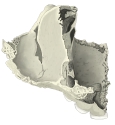 Right maxilla (superior view)
Reference websites
[Wikipedia]
· Maxilla, Wikipedia.
Related terms
- Body of maxilla
- Orbit
- Infraorbital groove
- Infraorbital suture
- Infraorbital foramen
- Maxillary sinus
- Maxilla
References and sources
- Further reading: Maxilla, Wikipedia.
- Federative International Programme for Anatomical Terminology (FIPAT). Terminologia Anatomica, 2nd ed. (TA2), 2019.