Styloglossus (Latin: musculus styloglossus)
- Overview
- Illustrations
- Origin / insertion
- Action
- Nerve / blood supply
- Reference websites
- (Wikipedia, websites with illustrations)
- Related terms
Overview
- Facial muscles (24)
- Muscles of mastication (4)
- Extra-ocular muscles (7)
- Muscles of the auditory ossicles (2)
- Muscles of the tongue
- Intrinsic muscles (4)
- Extrinsic muscles (4) : genioglossus, hyoglossus (with the chondroglossus), styloglossus, palatoglossus
- Muscles of the soft palate and fauces (5)
· It is the shortest and smallest of the three muscles that arise from the styloid process; the other two are the stylohyoid and the stylopharyngeus.
· It runs downward and forward between the internal carotid artery and the external carotid artery and enters the side of the tongue near its upper surface.
The muscles of the tongue at a glance:
| Group | Muscle | Course |
|---|---|---|
| Extrinsic | Genioglossus | from the genioglossus spine of the mandible, fanning out backward and upward into the tongue |
| Hyoglossus | a thin, four-sided sheet from the hyoid bone to the side of the tongue, lateral to the genioglossus | |
| Styloglossus | from the styloid process and the stylomandibular ligament, along the side of the tongue to near its tip | |
| Palatoglossus | from the soft palate down to the side of the tongue (also counted among the muscles of the soft palate) | |
| Chondroglossus | from the lesser horn of the hyoid bone forward and upward into the tongue (often treated as part of the hyoglossus) | |
| Intrinsic | Superior longitudinal | just under the mucosa of the dorsum, from the root to the tip of the tongue |
| Inferior longitudinal | near the lower surface, between the genioglossus and the hyoglossus, from the root to the tip | |
| Transverse | mostly from the median septum to the margins of the tongue | |
| Vertical | from the dorsum down to the lower surface, in the front and side parts of the tongue |
Sources differ on which muscles are counted as extrinsic: some count the chondroglossus in place of the palatoglossus.
Illustrations
More figures: Muscles of the tongue 1 · Muscles of the tongue 2 · Tongue to pharynx (left lateral view) · Muscles of the head (list)
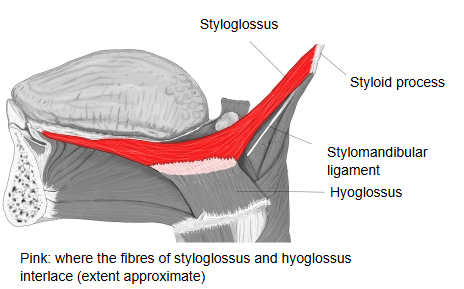
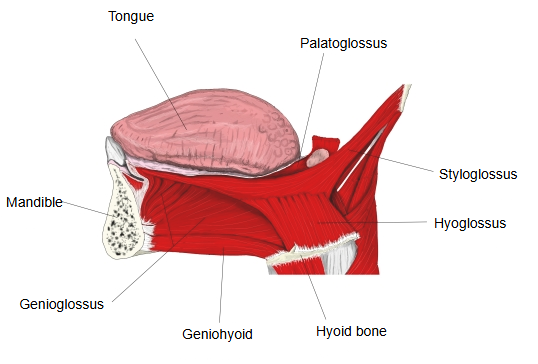
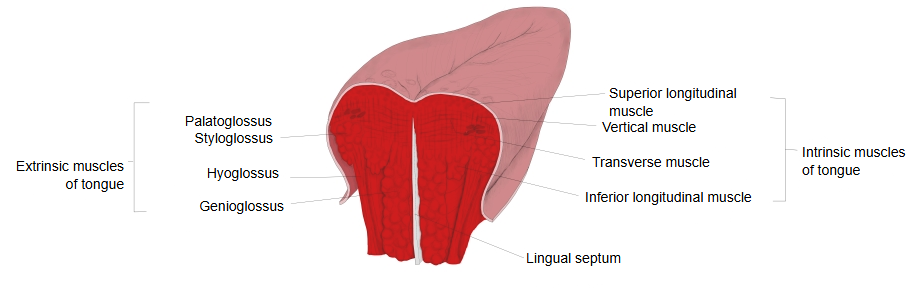
Origin / insertion
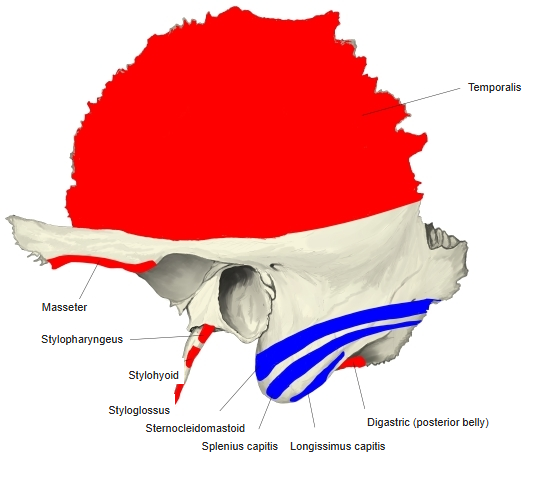
[Origin] : the front and lateral surfaces of the styloid process of the temporal bone near its tip, and the stylomandibular ligament.
[Insertion] : the side of the tongue. At the side of the tongue the muscle divides into two parts:
Longitudinal part : runs forward along the margin of the tongue toward the tip and blends with the inferior longitudinal muscle in front of the hyoglossus.
Oblique part : overlaps the hyoglossus and interlaces with its fibres, so that the fibres of the two muscles cross.
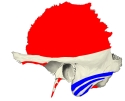 Temporal bone (muscle attachments)
Action
Draws the tongue upward and backward. By pulling up the sides of the tongue it forms a trough that helps to move food back during swallowing. Acting together, the two muscles help to retract the protruded tongue.
Nerve / blood supply
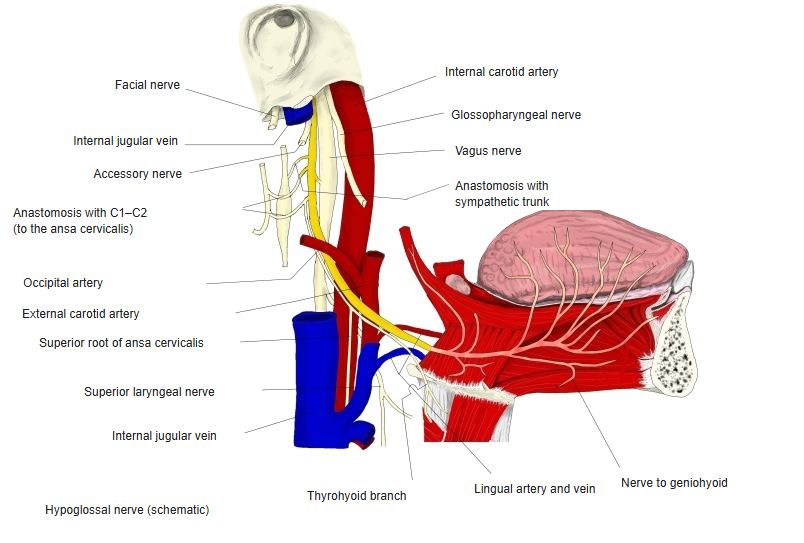
· Nerve : hypoglossal nerve (cranial nerve XII), like all the muscles of the tongue except the palatoglossus (which is supplied through the pharyngeal plexus from the vagus nerve).
· Arteries : mainly the lingual artery (its dorsal lingual branches).
· Veins : the lingual vein and its tributaries (such as the dorsal lingual vein).
 Hypoglossal nerve
Reference websites
[Wikipedia]
· Styloglossus, Wikipedia.
[Websites with illustrations]
· The tongue: muscles, innervation, vasculature (TeachMeAnatomy)
Related terms
- Extrinsic muscles of tongue
- Muscles of tongue
- Styloid process
- Margin of tongue
- Hyoglossus
- Genioglossus
- Stylohyoid
- Stylopharyngeus
- Stylomandibular ligament
- Hypoglossal nerve
- Tongue
References and sources
- FIPAT. Terminologia Anatomica, 2nd ed. (TA2), 2019: musculus styloglossus.
- Styloglossus, Wikipedia.