Thyropharyngeus (Latin: pars thyropharyngea musculi constrictoris pharyngis inferioris)
- Overview
- Illustrations
- Origin / insertion
- Action
- Nerve / blood supply
- Reference websites
- (Wikipedia, websites with illustrations)
- Related terms
Overview
- Superficial muscles of the neck (10)
- Deep muscles of the neck (8)
- Muscles of the pharynx (6)
- Pharyngeal constrictors (3) : superior, middle, inferior (its two parts: thyropharyngeus and cricopharyngeus)
- Pharyngeal elevators (3) : stylopharyngeus, salpingopharyngeus, palatopharyngeus
- Thyropharyngeal part : the part arising from the thyroid cartilage: thyropharyngeus
- Cricopharyngeal part : the part arising from the cricoid cartilage: cricopharyngeus
· Its fibres fan out backward and upward around the side of the pharynx to the pharyngeal raphe in the midline at the back. The upper fibres rise steeply and overlap the lower part of the middle constrictor.
· Between the oblique fibres of the thyropharyngeus and the horizontal fibres of the cricopharyngeus, at the back of the lower pharynx, there is a weak triangular area (Killian's dehiscence). A pharyngeal pouch (Zenker's diverticulum) can push out through it.
Illustrations
More figures: Pharyngeal constrictors (posterior view) · Pharyngeal constrictors (lateral view) · Pharynx and esophagus (posterior view) · Muscles of the neck (list) · Pharynx
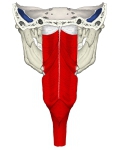 Pharyngeal constrictors (posterior view)
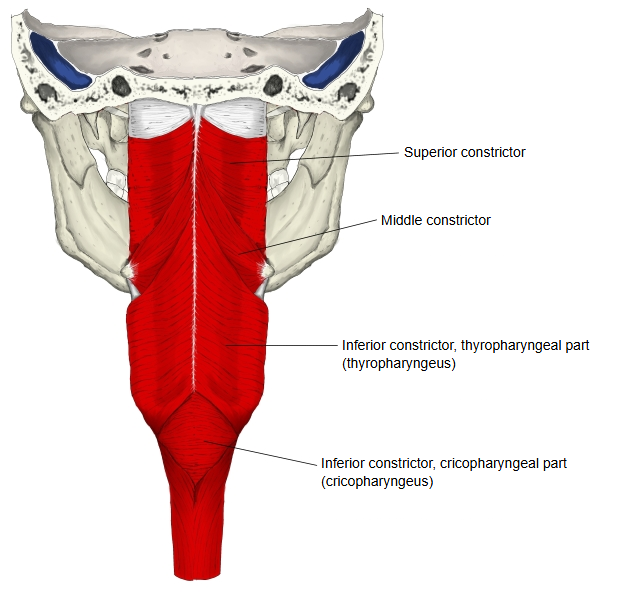
Origin / insertion
[Origin] : the oblique line of the thyroid cartilage, the area behind it and a small part of the inferior horn, and a tendinous arch that spans the cricothyroid between the thyroid and cricoid cartilages.
[Insertion] : the pharyngeal raphe, meeting the muscle of the other side in the midline at the back of the pharynx.
Action
Narrows the lower part of the pharynx. During swallowing the constrictors contract in sequence from above downward and push the food toward the esophagus. Unlike the cricopharyngeus, which stays contracted at rest as the upper esophageal sphincter, the thyropharyngeus acts only during swallowing.
Nerve / blood supply
· Nerve : the pharyngeal plexus, mainly through the pharyngeal branches of the vagus nerve. It also receives twigs from the external branch of the superior laryngeal nerve and, in its lower part, from the recurrent laryngeal nerve (sources differ on these extra branches).
· Arteries : pharyngeal branches of the ascending pharyngeal artery, muscular branches of the superior thyroid artery and the pharyngeal branches of the inferior thyroid artery.
· Veins : the pharyngeal venous plexus, drained by the pharyngeal veins to the internal jugular vein.
Reference websites
[Wikipedia]
· Inferior pharyngeal constrictor muscle, Wikipedia.
[Websites with illustrations]
· The pharynx (TeachMeAnatomy)
Related terms
- Thyropharyngeus (glossary)
- Constrictors of pharynx
- Thyroid cartilage
- Oblique line of thyroid cartilage
- Pharyngeal raphe
- Inferior pharyngeal constrictor
- Cricopharyngeus
- Middle pharyngeal constrictor
- Pharyngeal plexus
- Pharynx
References and sources
- FIPAT. Terminologia Anatomica, 2nd ed. (TA2), 2019: musculus constrictor pharyngis inferior, pars thyropharyngea (musculus thyropharyngeus).
- Inferior pharyngeal constrictor muscle, Wikipedia.