Interleukin
IL
One of the cytokines secreted by the cells of the immune system.
More details
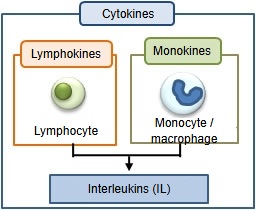
Interleukins are cytokines secreted mainly by white blood cells: most by helper T cells, and also by lymphocytes of other kinds, monocytes, macrophages and some other cells. Acting through receptors on their target cells, they control the growth, differentiation and activation of immune cells. They are written "IL" with a number; the human genome encodes more than 50 interleukins and related proteins.
Some examples:
| 1 | IL-1 | Secreted by macrophages, monocytes and other cells; takes part in inflammation, fever and the acute-phase response. |
| 2 | IL-2 | Secreted by activated T cells; makes T cells proliferate. It is used in immunotherapy for some cancers. |
| 3 | IL-3 | Secreted by activated T cells and mast cells; stimulates the production and differentiation of blood cells from haematopoietic stem and progenitor cells in the bone marrow. |
| 4 | IL-4 | Made by helper T cells; helps B cells proliferate and switch the class of antibody they make. Important in allergic reactions. |
| 5 | IL-5 | Made by helper T cells and mast cells; regulates the growth and activation of eosinophils. |
Related terms
References and sources
- Further reading: Interleukin, Wikipedia.
- Federative International Programme for Anatomical Terminology (FIPAT). Terminologia Anatomica, 2nd ed. (TA2), 2019.