General organization of the abdomen
- 1. The abdomen divides in two
- 2. The abdominal cavity divides into front and back
- 3. Parietal peritoneum folds into a double layer
- 4. Two ways a mesentery meets organs
- Reference websites
- (Wikipedia)
- Related terms
1. The abdomen divides in two
The abdomen has two main parts. One is the surrounding framework, the abdominal wall.
The other is the space inside it that holds the internal organs, the abdominal cavity.
Think of a cardboard box: the box itself is the abdominal wall, and the space that holds its contents is the abdominal cavity.
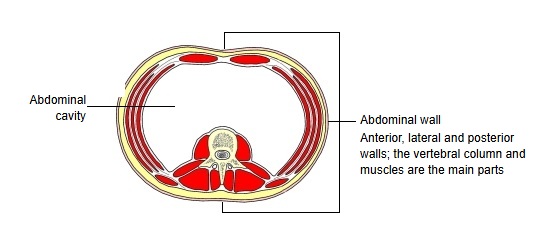
2. The abdominal cavity divides into front and back
The abdominal cavity, which holds the organs, can be divided further into a front part and a back part.
The front part is surrounded by peritoneum (a serous membrane). It has no particular name of its own. The organs in it are called intraperitoneal organs.
The peritoneum of the abdomen is of two kinds: parietal peritoneum, which lines the inside of the walls, and visceral peritoneum, which covers the organs.
2. This front part is not the same as the peritoneal cavity, which is only the very thin space between the two kinds of peritoneum, holding a small amount of serous fluid.
The back part, immediately in front of the posterior abdominal wall, is the retroperitoneum (retroperitoneal space).
The organs in it are called retroperitoneal organs and are divided into primary and secondary ones.
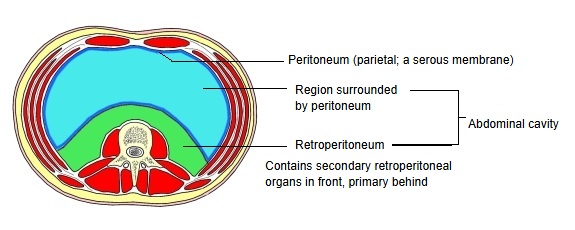
3. Parietal peritoneum folds into a double layer
The parietal peritoneum does more than line the inside of the abdominal wall: it folds back into a double layer and extends into the cavity. This double layer is called a mesentery.
What it does
1. 1. It leads nerves, blood vessels and lymphatics to the organs.
2. 2. It connects the organs to the abdominal wall and holds them steady.
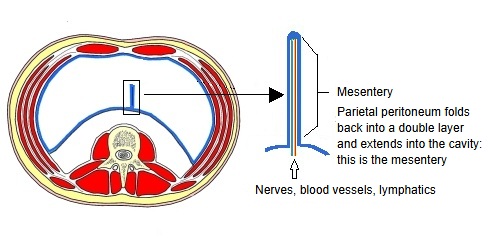
4. Two ways a mesentery meets organs
1. 1. It wraps the gut and suspends it from the parietal peritoneum: the mesentery of the small intestine, for example, which holds the intestinal tract.
2. 2. It attaches to only part of an organ and ties it to the abdominal wall, the diaphragm or another organ: the falciform ligament, for example, joins the liver to the anterior abdominal wall and the diaphragm.
Reference websites
[Wikipedia]
· Abdominal cavity, Wikipedia.
· Peritoneum, Wikipedia.
Related terms
- Mesenteries
- Abdominal wall
- Abdominal cavity
- Peritoneal cavity
- Retroperitoneum
- Retroperitoneal organs
- Intraperitoneal organs
- Parietal peritoneum
References and sources
- Further reading: Abdominal cavity, Wikipedia.
- Further reading: Peritoneum, Wikipedia.
- Federative International Programme for Anatomical Terminology (FIPAT). Terminologia Anatomica, 2nd ed. (TA2), 2019.