Visceral peritoneum (Latin: peritoneum viscerale)
Also called Visceral layer of peritoneum
- Overview
- Intraperitoneal organs
- Reference websites
- (Wikipedia, websites with illustrations)
- Where it is found
- Related terms
Overview
· It is also called the "visceral layer" of the peritoneum.
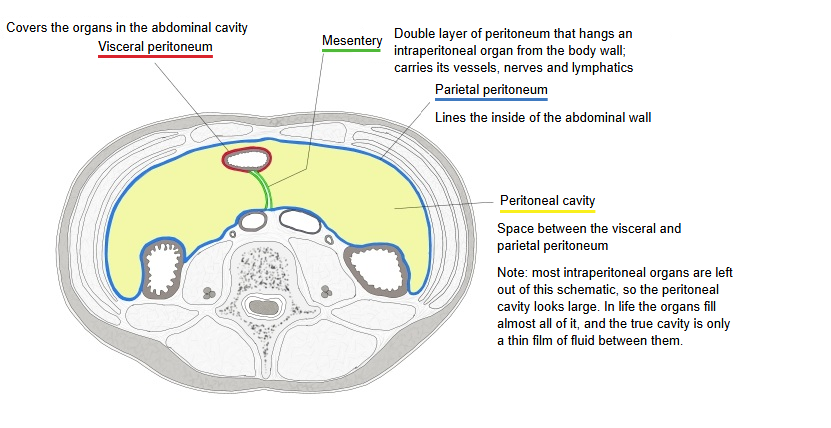
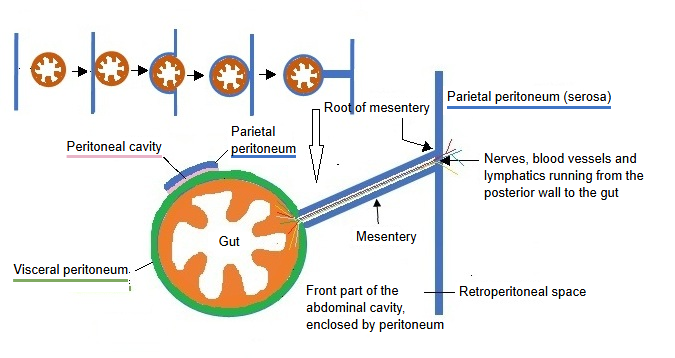
· It is continuous with the parietal peritoneum at the roots of the mesenteries and peritoneal ligaments. Unlike the parietal layer, it is firmly attached to its organ and cannot normally be stripped off.
· It shares the blood supply and the autonomic nerves of its organ. It is sensitive to stretch and chemical irritation but not to cutting, so its pain is dull, poorly localised and often referred (compare the visceral pleura).
toneum
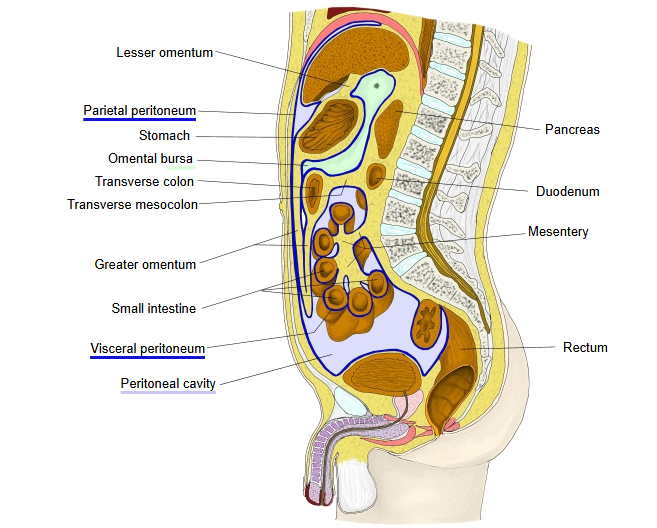
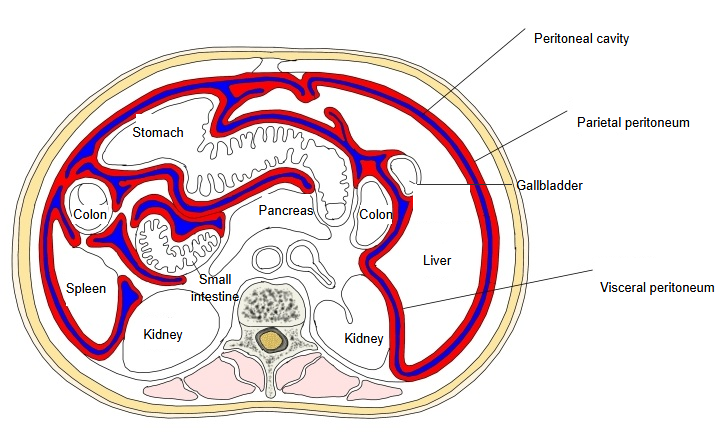
- Parietal peritoneum : the peritoneum lining the inner surface of the abdominal and pelvic cavities; also called the parietal layer.
- Visceral peritoneum : the peritoneum covering the surface of the organs in the abdominal and pelvic cavities; also called the visceral layer. Between the two layers is a thin film of serous fluid.
 Abdomen and pelvis (median section)
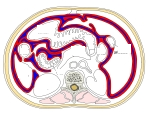 Abdomen (transverse section, schematic)
Intraperitoneal organs
① hollow (tube-like) organs wrapped almost all round by the visceral peritoneum (the main group);
② solid organs of which only a part is covered by the visceral peritoneum.
| Organ | Class | Peritoneal covering | Notes | |
|---|---|---|---|---|
| 1 | Stomach | Intraperitoneal | almost all round | Gastrosplenic ligament, gastrophrenic ligament |
| 2 | Jejunum | The mesentery | ||
| 3 | Ileum | The mesentery | ||
| 4 | Caecum | Usually no mesentery; sometimes a mesocaecum | ||
| 5 | Appendix | Mesoappendix | ||
| 6 | Transverse colon | Transverse mesocolon | ||
| 7 | Sigmoid colon | Sigmoid mesocolon | ||
| 8 | Spleen | Gastrosplenic ligament, splenorenal ligament | ||
| Pancreas (tail) | The tail reaches the spleen inside the splenorenal ligament | |||
| 9 | Liver | Intraperitoneal (exceptional type) | most of the surface | Has a bare area (upper posterior part) lying directly on the diaphragm |
| 10 | Gallbladder | partial | The upper surface (gallbladder bed on the liver) has no peritoneum | |
| 11 | Duodenum (first part: bulb) | Partly intraperitoneal | front and back | Most of it (parts 2–4) is a secondarily retroperitoneal organ |
| 12 | Rectum (upper and middle parts) | partial | The upper part is covered on the front and sides and the middle part on the front only; the rest lies below the peritoneum (subperitoneal). |
· The spleen is covered except at its hilum, and the liver except for its bare area and the gallbladder bed. In general, hollow tubular organs tend to be wrapped almost all round, while solid organs are covered only in part; sources differ on partly covered organs such as the caecum, gallbladder and upper rectum.
Reference websites
[Wikipedia]
· Peritoneum, Wikipedia.
[Websites with illustrations]
· Organ coverings of the abdominal cavity (figure) (SlideShare)

· The peritoneum: visceral and parietal (TeachMeAnatomy)
In short: the visceral peritoneum is the continuation of the parietal peritoneum, reflected onto the organs. It wraps almost all round the stomach, the jejunum and ileum, the appendix, the transverse and sigmoid colon and the spleen, and covers most of the liver; it covers only part of other organs, such as the front of the secondarily retroperitoneal organs (most of the duodenum, the ascending and descending colon), the upper rectum and, in the pelvis, the bladder and (in the female) the uterus. Through its folds, the mesenteries, the omenta and the peritoneal ligaments, it holds the organs in place. The potential space between the visceral and parietal layers is the peritoneal cavity, which communicates through the omental foramen with the omental bursa (lesser sac).
Where it is found
Related terms
- Parietal peritoneum
- Peritoneal cavity
- Peritoneum
- Mesentery
- Transverse mesocolon
- Mesoappendix
- Visceral pleura
References and sources
- Further reading: Peritoneum, Wikipedia.
- Further reading: Intraperitoneal organs, Wikipedia.
- Federative International Programme for Anatomical Terminology (FIPAT). Terminologia Anatomica, 2nd ed. (TA2), 2019.