Distal epiphysis of humerus
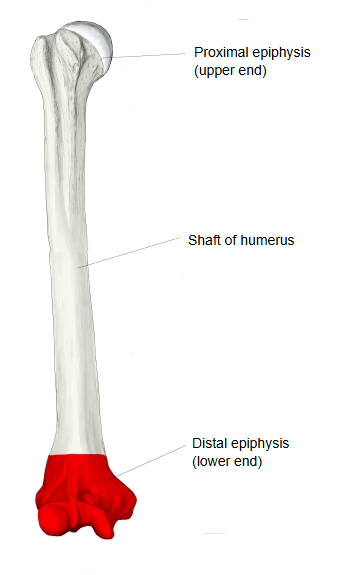
Also called the lower end of humerus
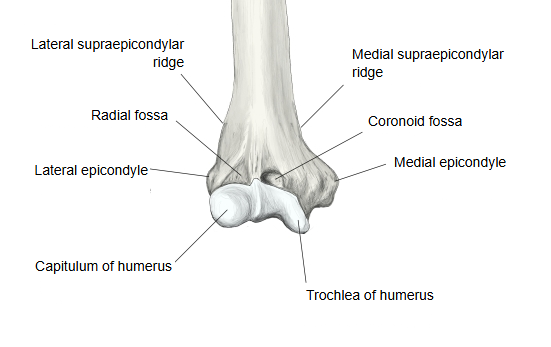
- It articulates with the radius and the ulna ⇒ elbow joint. The articular part is the condyle: the rounded capitulum laterally, for the radius, and the pulley-shaped trochlea medially, for the ulna.
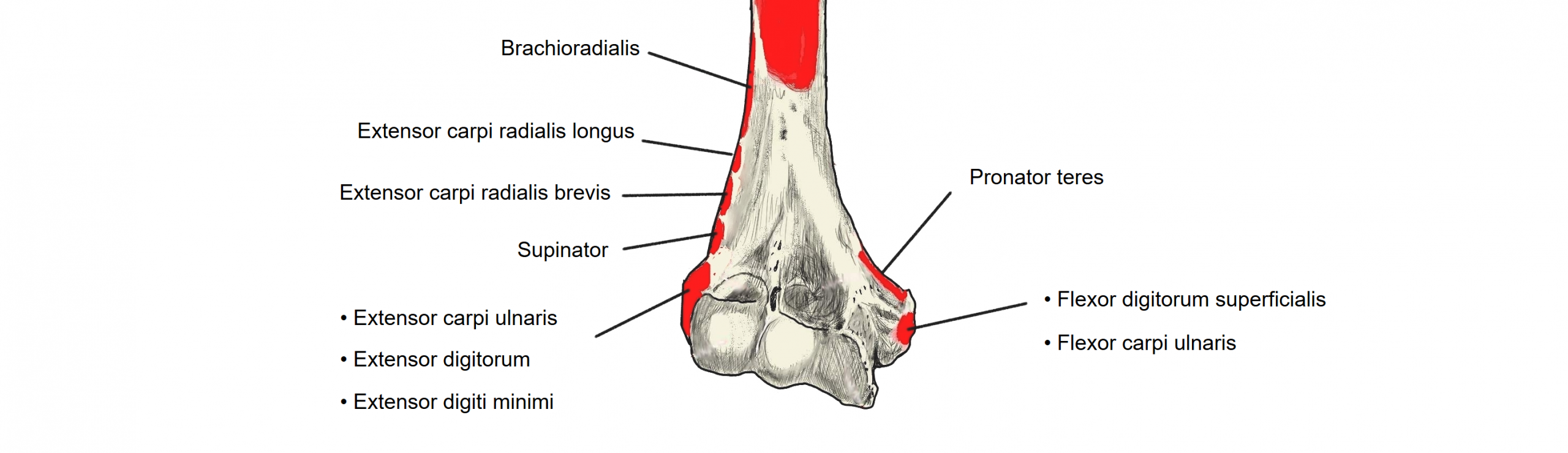
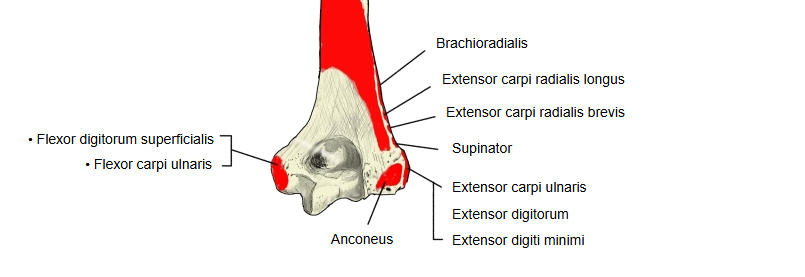
- Muscles arising (origin): extensor carpi radialis longus, extensor carpi radialis brevis, supinator, extensor carpi ulnaris, extensor digitorum, extensor digiti minimi, pronator teres, flexor carpi radialis, palmaris longus, flexor digitorum superficialis, flexor carpi ulnaris, anconeus and, from the lateral supracondylar ridge, brachioradialis.
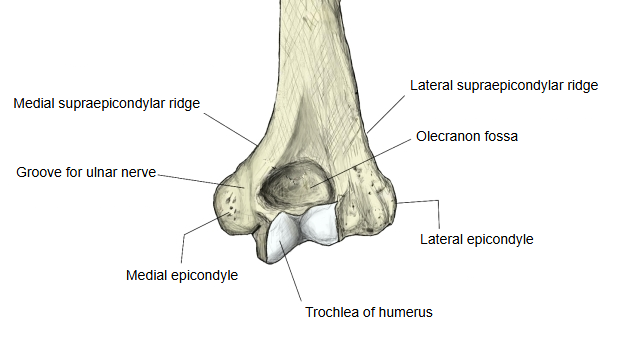
- Related terms: medial epicondyle, lateral epicondyle, groove for the ulnar nerve, trochlea, capitulum, coronoid fossa, radial fossa, olecranon fossa.
The non-articular part carries the medial and lateral epicondyles, the medial and lateral supracondylar ridges above them, and three fossae: the coronoid and radial fossae in front and the olecranon fossa behind. The common extensor origin is on the lateral epicondyle and the common flexor origin on the medial epicondyle. The ulnar nerve runs in a groove on the back of the medial epicondyle.
- Upper end : the enlarged upper end = proximal epiphysis
- Body (shaft) of humerus : the central part
- Lower end : the enlarged lower end = distal epiphysis
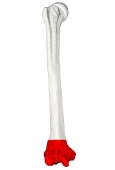 Distal epiphysis (red)
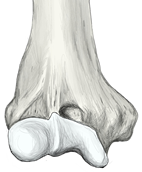 Lower end (anterior)
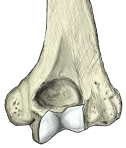 Lower end (posterior)
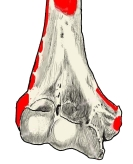 Muscle attachments (anterior)
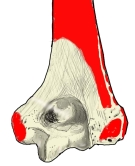 Muscle attachments (posterior)
Reference websites
[Wikipedia]
· Humerus, Wikipedia.
· Elbow, Wikipedia.
[Websites with illustrations]
· Inferior epiphysis of the humerus (anterior view) (Wikimedia Commons)

· Left humerus, anterior view (Gray's Anatomy, fig. 207) (Wikimedia Commons)

· Left humerus, posterior view (Gray's Anatomy, fig. 208) (Wikimedia Commons)

· The humerus: proximal, shaft and distal parts (TeachMeAnatomy)
Where it is found
Related terms
- Humerus
- Shaft of humerus
- Condyle of humerus
- Capitulum of humerus
- Trochlea of humerus
- Medial epicondyle
- Lateral epicondyle