Greater trochanter (Latin: trochanter major)
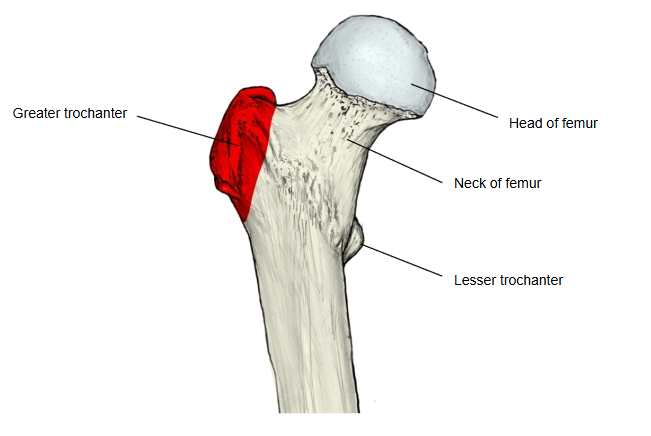
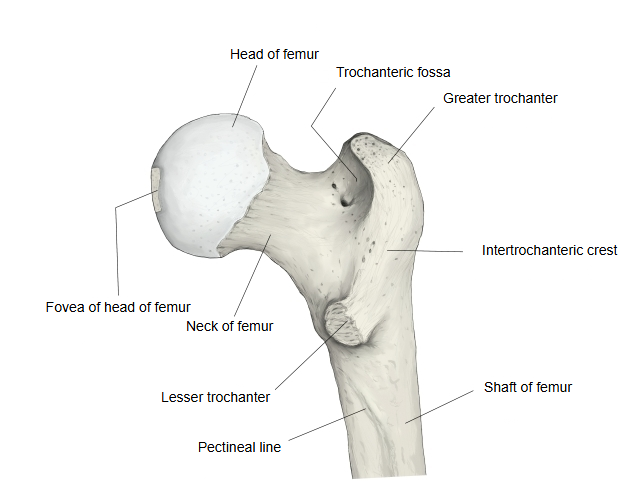
The part of the proximal epiphysis of the femur that projects upwards and laterally where the neck joins the shaft. It can be felt under the skin on the side of the hip, about a hand's breadth below the iliac crest, and gives attachment to gluteus medius, gluteus minimus and piriformis. On its back and medial side, near the root of the neck of femur, is a deep pit, the trochanteric fossa, for obturator externus; obturator internus and the gemelli insert just above it.
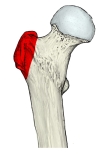 Right femur (upper end, anterior)
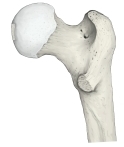 Right femur (upper end, posterior)
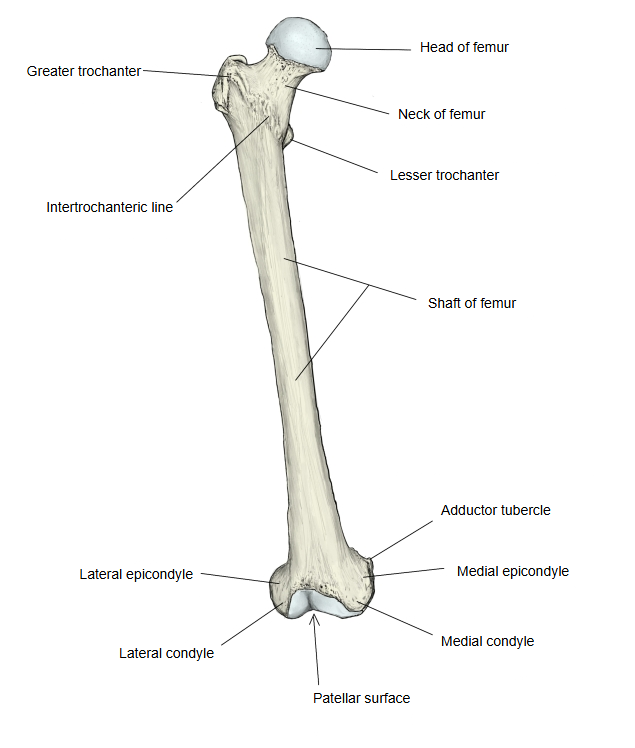
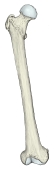 Right femur (anterior)
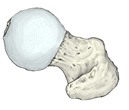 Right femur (upper end, from above)
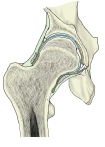 Right hip joint (coronal section)
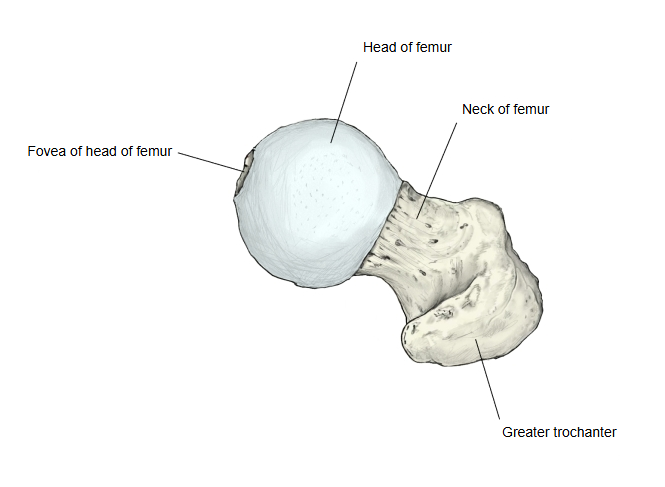
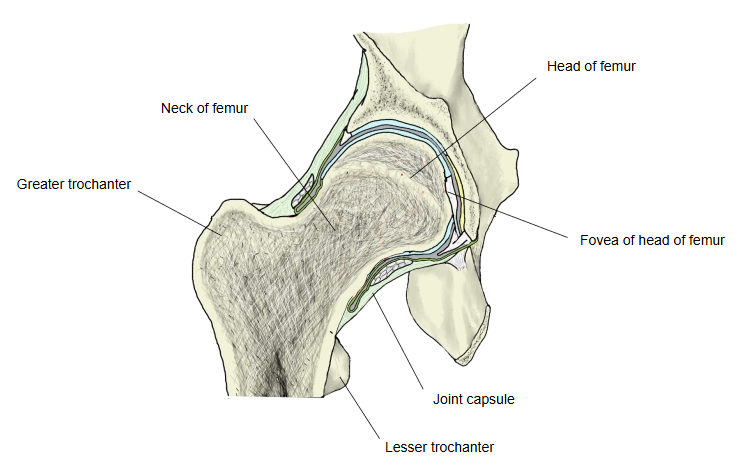
[Attachments]
| Muscles | 1 | Gluteus minimus | front of the greater trochanter | 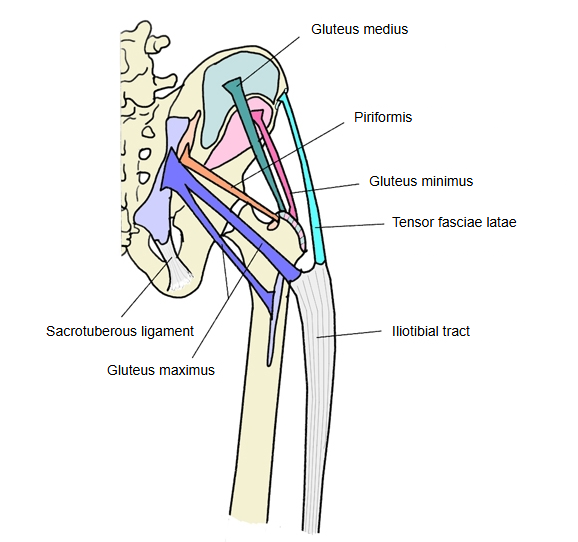 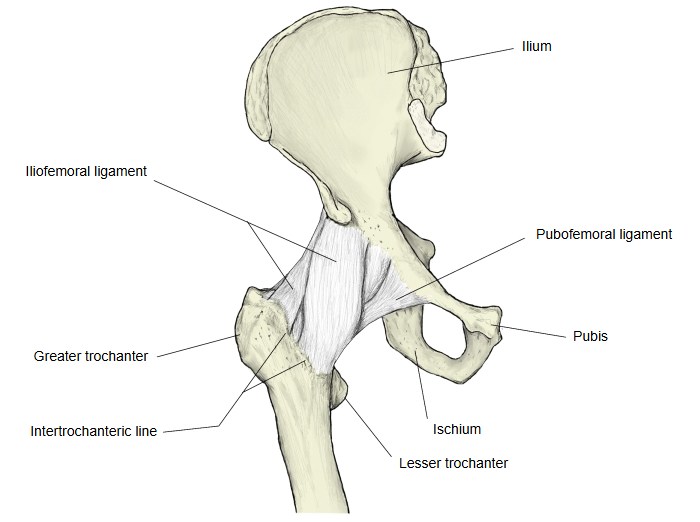 |
| 2 | Gluteus medius | lateral surface | ||
| 3 | Piriformis | upper border | ||
| Ligament | 1 | Iliofemoral ligament | near its front edge, along the intertrochanteric line |
The greater trochanter is a large, irregular, roughly four-sided projection, directed laterally and slightly backwards. In adults its top lies about level with the centre of the head of femur, and so below the top of the head. In front it is joined to the lesser trochanter by the intertrochanteric line, and behind by the intertrochanteric crest. Because the female pelvis is wider, the distance between the two greater trochanters is relatively larger in women. It develops from a separate centre of ossification (a traction epiphysis), shaped by the pull of the muscles attached to it, and forms part of the hip joint region.
Reference websites
[Wikipedia]
· Greater trochanter, Wikipedia.
· Femur, Wikipedia.
[Websites with illustrations]
· Right femur, anterior surface (Gray's Anatomy) (Wikimedia Commons)

· Upper end of the femur, posterior view (photograph) (Wikimedia Commons)

· The femur (TeachMeAnatomy)
Where it is found
Related terms
- Trochanteric fossa
- Lesser trochanter
- Intertrochanteric line
- Intertrochanteric crest
- Neck of femur
- Proximal epiphysis of femur
- Hip joint
References and sources
- Further reading: Greater trochanter, Wikipedia.
- Further reading: Femur, Wikipedia.
- Federative International Programme for Anatomical Terminology (FIPAT). Terminologia Anatomica, 2nd ed. (TA2), 2019.