Lateral lip of linea aspera (Latin: labium laterale lineae asperae)
Also called the lateral lip
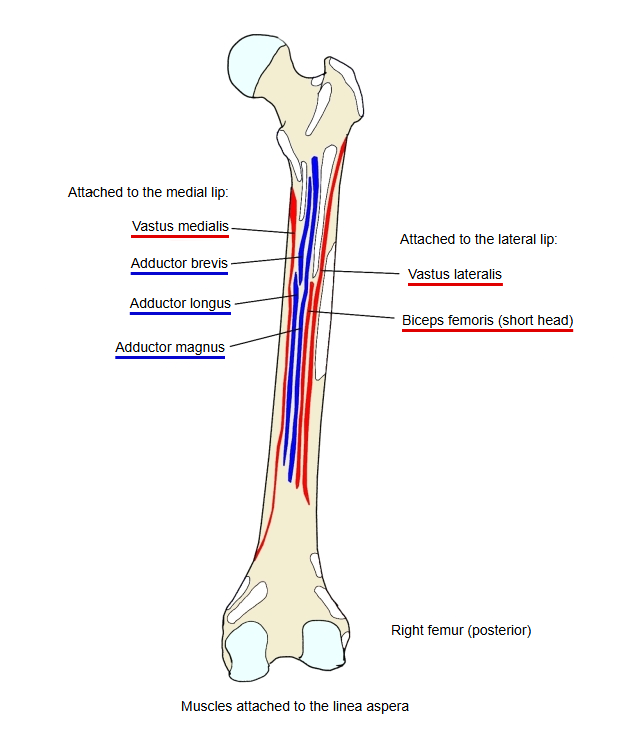
- Medial lip : vastus medialis, adductor magnus, adductor longus, adductor brevis
- Lateral lip : vastus lateralis, biceps femoris (short head)
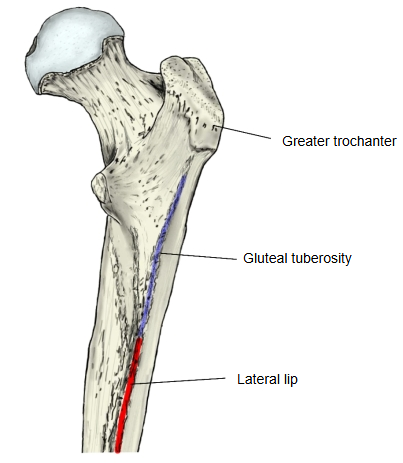
Above, it passes into the gluteal tuberosity and runs up to the base of the greater trochanter.
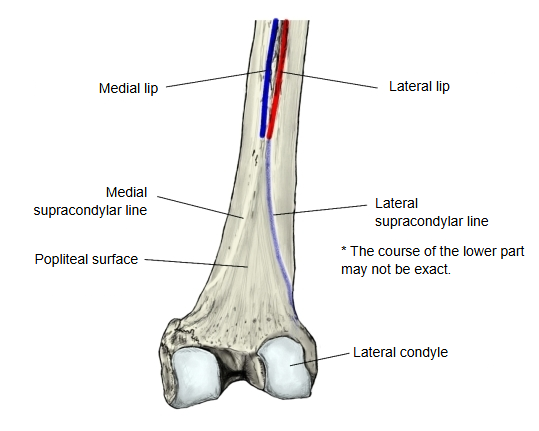
Below, it passes into the lateral supracondylar line and reaches the lateral condyle.
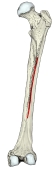 Right femur (posterior)
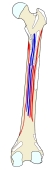 Muscles on the linea aspera
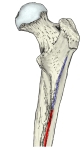 Upper end of the lateral lip
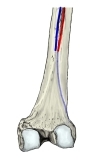 Lower end of the lateral lip
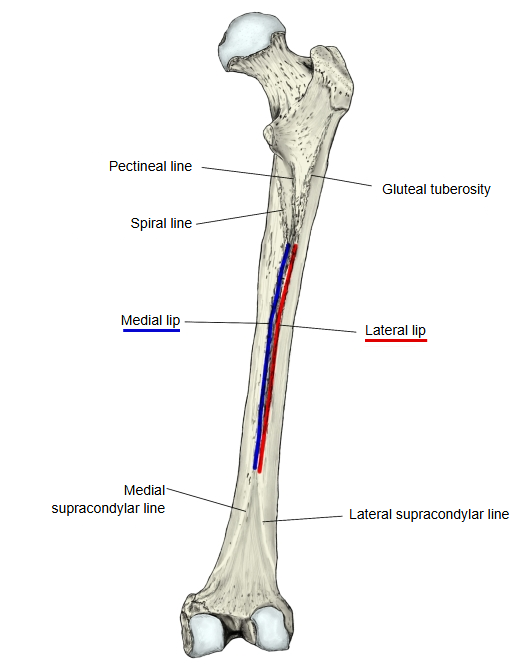
· It runs down the middle third of the back of the shaft of the femur beside the medial lip; the two lips together form the linea aspera.
· Besides vastus lateralis and the short head of biceps femoris (both origins), the lateral intermuscular septum of the thigh is attached to it.
Reference websites
[Wikipedia]
· Linea aspera, Wikipedia.
· Femur, Wikipedia.
[Websites with illustrations]
· Right femur, posterior surface (Gray's Anatomy, fig. 245) (Wikimedia Commons)

Where it is found
Related terms
- Linea aspera
- Medial lip of linea aspera
- Gluteal tuberosity
- Lateral supracondylar line
- Greater trochanter
- Shaft of femur
References and sources
- Further reading: Linea aspera, Wikipedia.
- Further reading: Femur, Wikipedia.
- Federative International Programme for Anatomical Terminology (FIPAT). Terminologia Anatomica, 2nd ed. (TA2), 2019.