Antihelix (Latin: antihelix)
Also called: anthelix
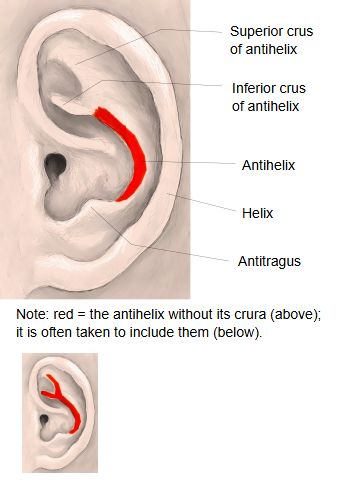
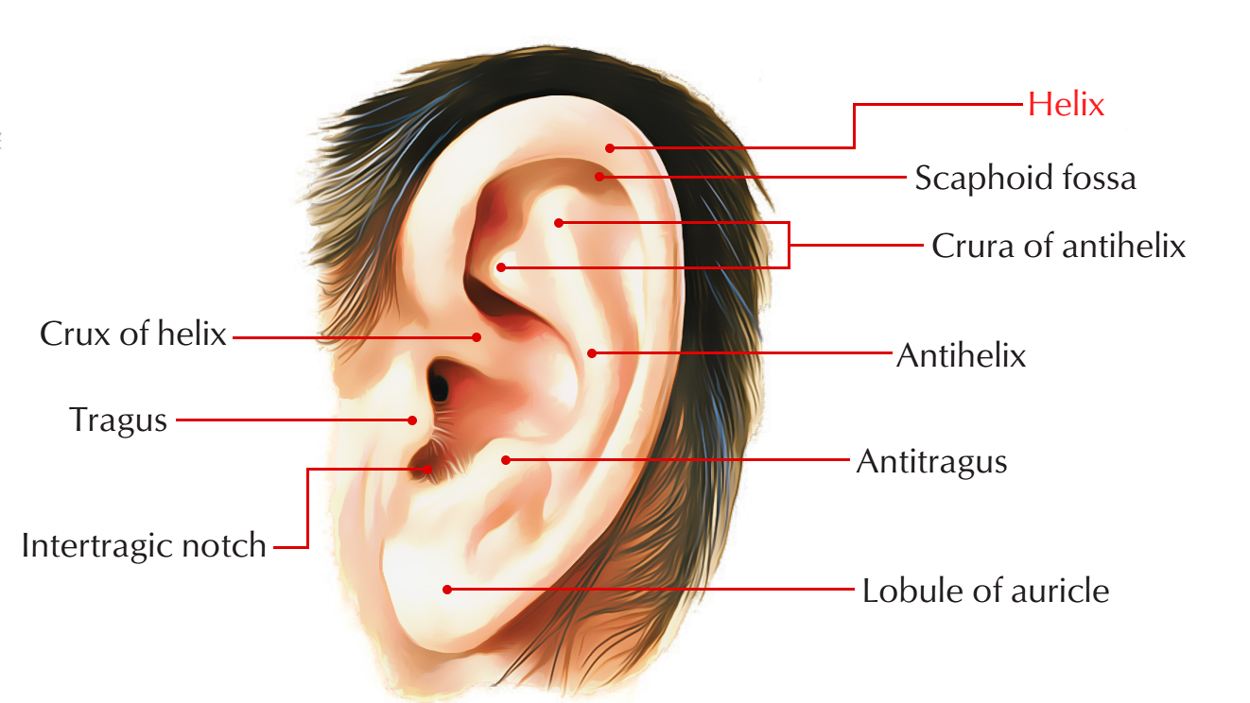
The antihelix is a ridge of auricular cartilage that runs roughly parallel to the helix, inside it. It curves up from just above the antitragus and bounds the concha behind and above. Between its two crura lies the triangular fossa, and the groove between the antihelix and the helix is the scaphoid fossa. In the cartilage, the small antitragohelicine fissure separates the antihelix and antitragus from the tail of the helix. On the cranial (back) surface of the auricle the antihelix corresponds to a groove, the fossa of antihelix. In the first figure the red area leaves out the crura; the name is often used for the ridge together with its crura.
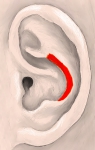 Left auricle (lateral surface)
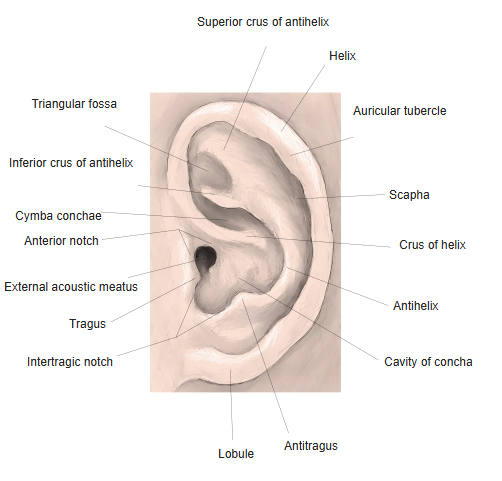
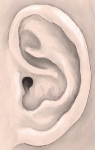 Parts of the auricle
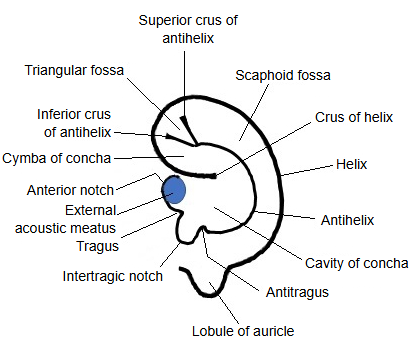
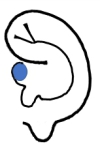 Left auricle (diagram)
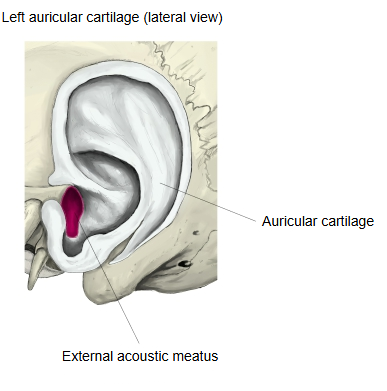
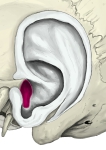 Left auricular cartilage (lateral surface)
Names of the parts of the auricle
The surface of the auricle is full of ridges and hollows, and its parts have the following names.
Note: the antitragohelicine fissure can also be seen from the lateral surface.
Reference websites
[Wikipedia]
· Antihelix, Wikipedia.
· Auricle (anatomy), Wikipedia.
[Websites with illustrations]
· Parts of the outer ear (Pioneer Valley Plastic Surgery)

· Helix and antihelix of the auricle (Earth's Lab)
· The auricle, lateral surface (Gray's Anatomy, fig. 904) (Wikimedia Commons)

Related terms
- Inferior crus of antihelix
- Superior crus of antihelix
- Helix
- Antitragus
- Concha of auricle
- Crus of helix
- Antitragohelicine fissure
- Auricular cartilage
- Auricle
References and sources
- Further reading: Antihelix, Wikipedia.
- Further reading: Auricle (anatomy), Wikipedia.
- Federative International Programme for Anatomical Terminology (FIPAT). Terminologia Anatomica, 2nd ed. (TA2), 2019.