Lobule of auricle (Latin: lobulus auriculae)
Also called the earlobe or the ear lobe
It is the soft lower part of the auricle, below the antitragus, made of fibrous and fatty connective tissue covered by skin, so it lacks the firmness and elasticity of the rest of the auricle. Its sensory nerve supply comes from the great auricular nerve.
Its shape varies: in some people it hangs free, in others it is attached to the side of the face. It has no clear function; because it contains no cartilage, it is the usual site for ear piercing and for taking a small blood sample.
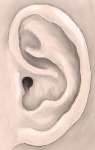 Parts of the auricle
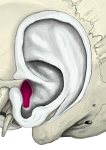 Left auricular cartilage
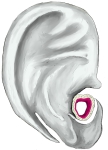 Left auricular cartilage (cranial surface)
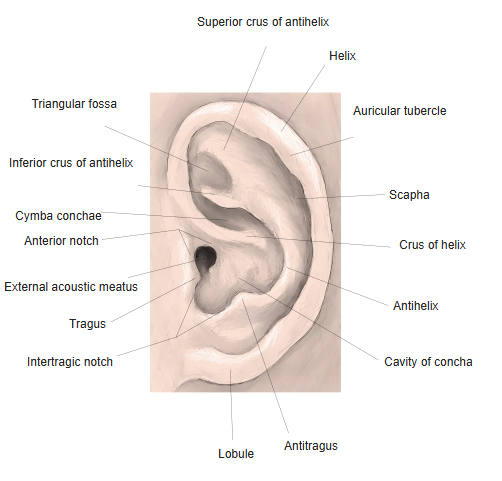
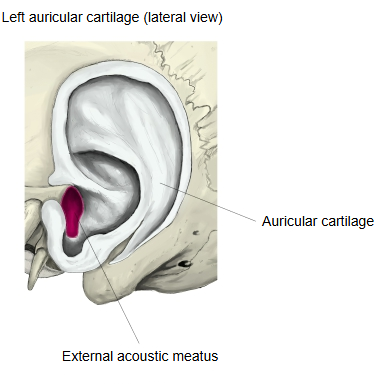
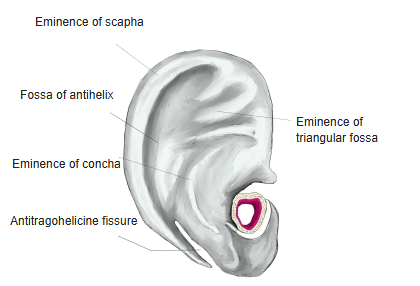
Names of the parts of the auricle
The surface of the auricle is full of ridges and hollows, and its parts have the following names.
Note: the antitragohelicine fissure can also be seen from the lateral surface.
Reference websites
[Wikipedia]
· Earlobe, Wikipedia.
· Auricle (anatomy), Wikipedia.
[Websites with illustrations]
· The auricle, lateral surface (Gray's Anatomy, fig. 904) (Wikimedia Commons)

Related terms
- Helix
- Crus of helix
- Spine of helix
- Cauda helicis
- Intertragic notch
- Tragus
- Auricle
- External ear
- Auricular cartilage
- Concha of auricle
- Auricular tubercle
- Anterior notch of auricle
References and sources
- Further reading: Earlobe, Wikipedia.
- Further reading: Auricle (anatomy), Wikipedia.
- Federative International Programme for Anatomical Terminology (FIPAT). Terminologia Anatomica, 2nd ed. (TA2), 2019.