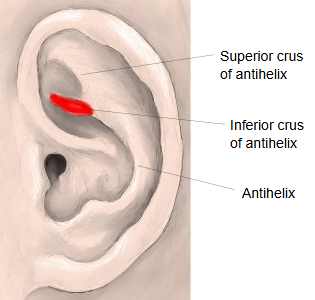
Inferior crus of antihelix (Latin: crus inferius antihelicis)
From the point where the antihelix splits, the inferior crus runs forward, almost horizontally. It forms the lower border of the triangular fossa and the upper border of the cymba of concha (the upper part of the concha). Its front end disappears under the helix, just above the crus of helix. It is usually sharper and more prominent than the superior crus of antihelix.
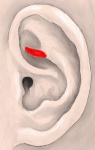 Left auricle (lateral surface)
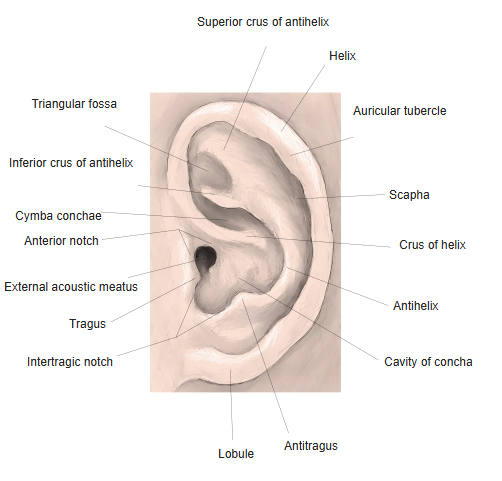
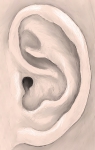 Left auricle (lateral surface)
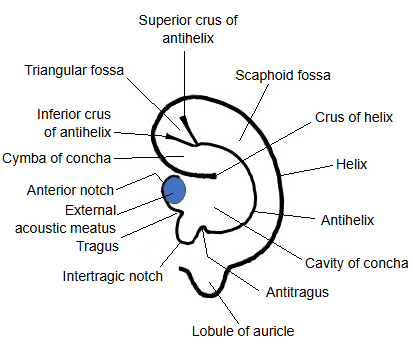
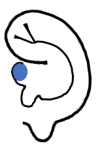 Left auricle (diagram)
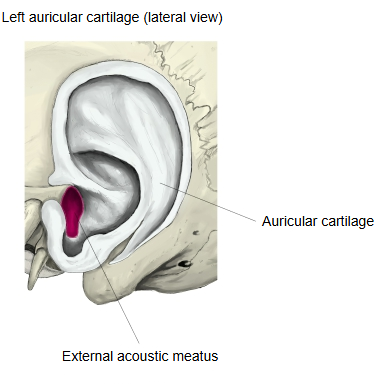
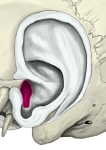 Left auricular cartilage (lateral surface)
Names of the parts of the auricle
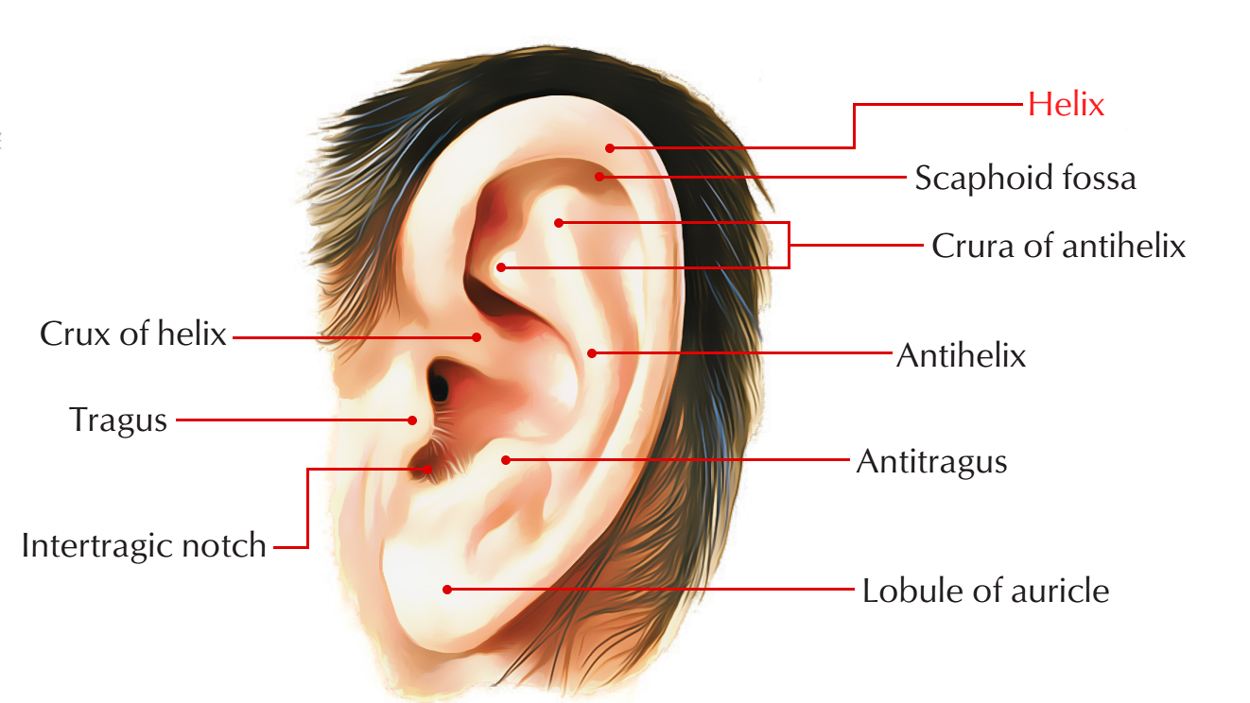
The surface of the auricle is full of ridges and hollows, and its parts have the following names.
| Lateral surface | 1 | Helix | 8 | Superior crus of antihelix | 15 | Tragus | Medial surface | 1 | Eminence of scapha |
| 2 | Auricular tubercle | 9 | Triangular fossa | 16 | Anterior notch | 2 | Eminence of concha | ||
| 3 | Crus of helix | 10 | Concha of auricle | 17 | External acoustic meatus | 3 | Fossa of antihelix | ||
| 4 | Spine of helix | 11 | Cymba of concha | 18 | Scaphoid fossa | 4 | Eminence of triangular fossa | ||
| 5 | Lobule of auricle | 12 | Cavity of concha | 19 | Tail of helix | 5 | |||
| 6 | Antihelix | 13 | Antitragus | 20 | Antitragohelicine fissure | ||||
| 7 | Inferior crus of antihelix | 14 | Intertragic notch |
Note: the antitragohelicine fissure can also be seen from the lateral surface.
Reference websites
[Wikipedia]
· Antihelix, Wikipedia.
· Auricle (anatomy), Wikipedia.
[Websites with illustrations]
· Parts of the outer ear (Pioneer Valley Plastic Surgery)

· Helix and antihelix of the auricle (Earth's Lab)
· The auricle, lateral surface (Gray's Anatomy, fig. 904) (Wikimedia Commons)

Related terms
- Antihelix
- Superior crus of antihelix
- Helix
- Crus of helix
- Concha of auricle
- Antitragus
- Auricular cartilage
- Auricle
References and sources
- Further reading: Antihelix, Wikipedia.
- Further reading: Auricle (anatomy), Wikipedia.
- Federative International Programme for Anatomical Terminology (FIPAT). Terminologia Anatomica, 2nd ed. (TA2), 2019.