Spine of helix (Latin: spina helicis)
· It is probably quite hard to make out through the skin.
· It is a small tubercle that runs forwards and downwards from the crus of helix.
The spine of helix is a small forward-pointing projection of the auricular cartilage at the front of the helix, where the helix bends upwards as the crus of helix; it lies just above the tragus. (At the lower end of the helix the cartilage is drawn out downwards as the cauda helicis.) It gives attachment to the anterior auricular ligament and to helicis major, one of the small intrinsic auricular muscles.
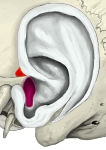 Left auricular cartilage (lateral)
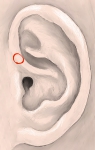 Left auricle (lateral surface)
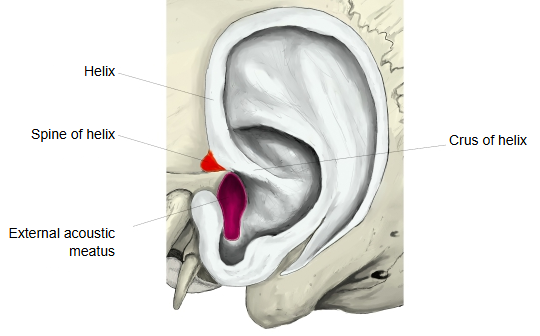
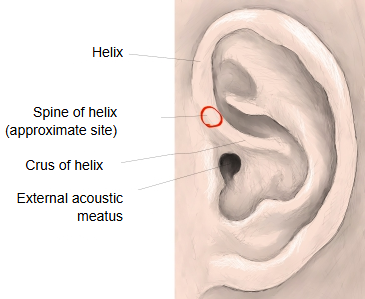
In the second figure the position of the spine is approximate.
Names of the parts of the auricle
The surface of the auricle is full of ridges and hollows, and its parts have the following names.
Note: the antitragohelicine fissure can also be seen from the lateral surface.
Reference websites
[Wikipedia]
· Helix (ear), Wikipedia.
· Auricle (anatomy), Wikipedia.
[Websites with illustrations]
· Cartilage of the auricle, cranial surface, with the spina helicis (Gray's Anatomy, fig. 905) (Wikimedia Commons)

Related terms
- Helix
- Crus of helix
- Cauda helicis
- Lobule of auricle
- Auricular cartilage
- Auricle
- Tragus
- Anterior notch of auricle
- Concha of auricle
- Auricular muscles
- External ear
References and sources
- Further reading: Helix (ear), Wikipedia.
- Further reading: Auricle (anatomy), Wikipedia.
- Federative International Programme for Anatomical Terminology (FIPAT). Terminologia Anatomica, 2nd ed. (TA2), 2019.