Deep back muscles
deep muscles of the back
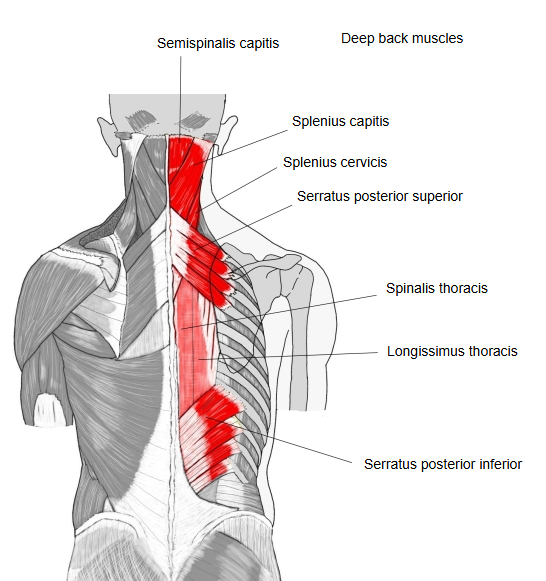
First layer: the spinocostal muscles, related functionally to the ribs: the serratus posterior superior and serratus posterior inferior, thin muscles from the vertebral spines to the ribs, supplied by the intercostal nerves.
Second layer: the intrinsic back muscles, related mainly to the vertebral column. They are supplied by the posterior rami of the spinal nerves and move the vertebral column and head.
By their form, the muscles of the second layer can be divided into three groups:
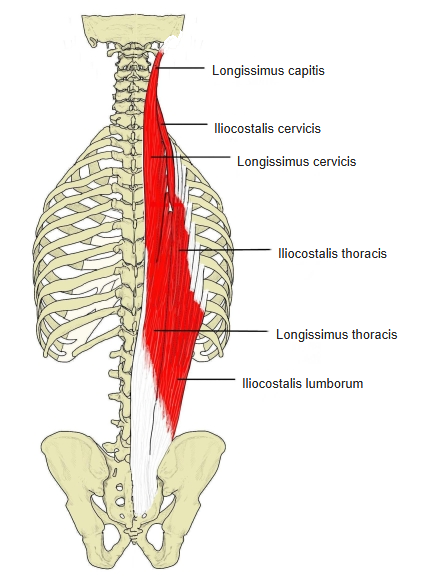
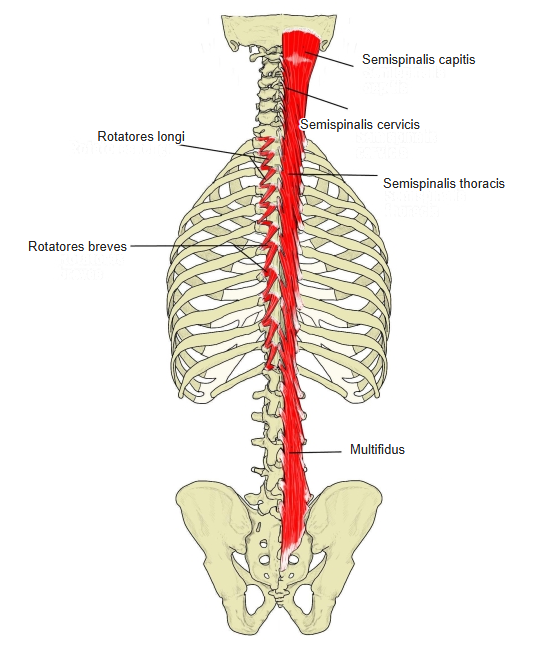
1. Long muscles running along much of the length of the vertebral column: the splenius muscles, the erector spinae (iliocostalis, longissimus, spinalis) and the transversospinalis muscles (semispinalis, multifidus, rotatores).
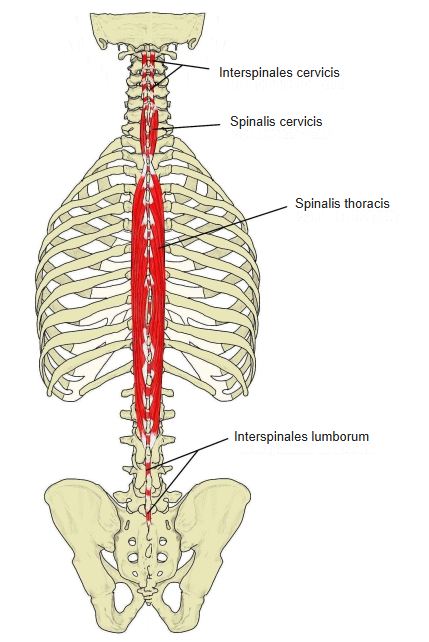
2. Short muscles between neighbouring vertebrae: the interspinales and the intertransversarii.
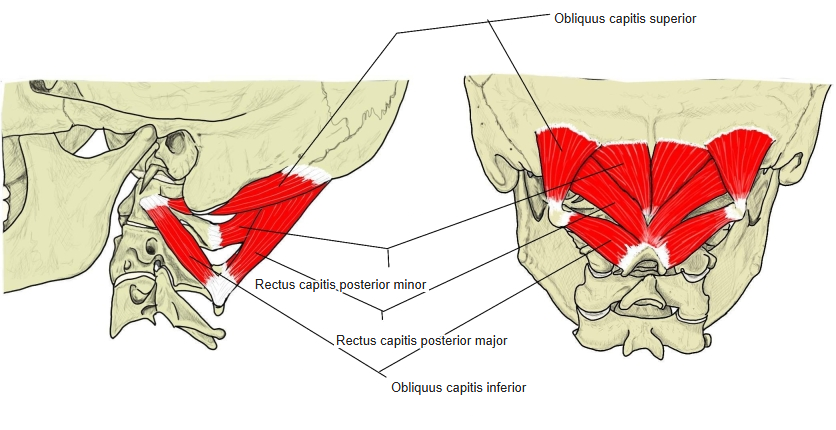
3. Short muscles between the occipital bone and the first and second cervical vertebrae: the suboccipital muscles.
The diagram below shows the muscles of the back in simple form (number of muscles in brackets).
- Superficial back muscles (5) : the spinohumeral muscles. First layer (2): trapezius, latissimus dorsi. Second layer (3): rhomboid major, rhomboid minor, levator scapulae.
- Deep back muscles (16)
- First layer (2) : the spinocostal muscles: serratus posterior superior and inferior.
- Second layer (14)
- Muscles of the vertebral column (10) : the intrinsic back muscles: splenius muscles (2), erector spinae (3), transversospinalis muscles (3), others (2: interspinales, intertransversarii).
- Suboccipital muscles (4) : rectus capitis posterior major and minor, obliquus capitis superior and inferior.
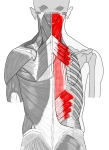 Deep back muscles
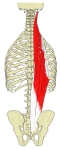 Erector spinae
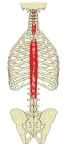 Spinalis and interspinales
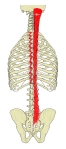 Semispinalis, multifidus and rotatores
 Suboccipital muscles
The muscles of the back are thus divided into a superficial group, which acts on the upper limb, and a deep group of two layers, which acts on the ribs, the vertebral column and the head; the suboccipital muscles are counted with them. Many texts instead list three groups: superficial, intermediate (the serratus posterior muscles) and deep (the intrinsic back muscles only). Sources differ, and "deep back muscles" is often used to mean the intrinsic back muscles alone.
Related terms
- Muscles of the back
- Intrinsic back muscles
- Serratus posterior superior
- Serratus posterior inferior
- Erector spinae
- Transversospinalis muscles
- Suboccipital muscles
References and sources
- Further reading: Erector spinae muscles, Wikipedia.
- Further reading: Serratus posterior superior muscle, Wikipedia.
- Federative International Programme for Anatomical Terminology (FIPAT). Terminologia Anatomica, 2nd ed. (TA2), 2019.