Intrinsic back muscles (Latin: musculi dorsi proprii)
Also called the deep back muscles
Their place among the back muscles:
muscles
(21)
- Superficial back muscles (5) : = spinohumeral muscles
- 1st layer (2)
- 2nd layer (3)
- Deep back muscles (16)
- 1st layer (2) : = spinocostal muscles
- 2nd layer (14)
- Muscles of the vertebral column (10) : = intrinsic back muscles, spinodorsal muscles
- Splenius (2)
- Erector spinae (3)
- Transversospinalis (3)
- Others (2)
- Suboccipital muscles (4)
- Muscles of the vertebral column (10) : = intrinsic back muscles, spinodorsal muscles
These are the ten intrinsic back muscles:
vertebral column (10)
= intrinsic back muscles
- Splenius (2) : splenius capitis, splenius cervicis
- Erector spinae (3) : iliocostalis, longissimus, spinalis
- Transversospinalis (3) : semispinalis, multifidus, rotatores
- Others (2) : interspinales, intertransversarii
They are the deepest group of back muscles, the true back muscles, and they differ clearly from the other back muscles in being supplied by the posterior rami of the spinal nerves. They fill the groove from the spinous processes over the vertebral arches and transverse processes to the angles of the ribs; above, they cover the back of the cervical vertebrae and reach the occipital bone, and below, after being well developed over the lumbar vertebrae, they reach the back of the sacrum and the iliac crest. They are divided lengthwise in a complex way, but fall into two main groups. The lateral tract, supplied by the lateral branches of the posterior rami, lies mainly over and lateral to the transverse processes, and its fibres tend to run from below and medial to above and lateral. The medial tract, supplied by the medial branches, lies close to the spinous processes, between them and the transverse processes, and its fibres tend to run from below and lateral to above and medial. By nerve supply they can be grouped as follows:
1. Intermediate between the ventral trunk muscles and the intrinsic back muscles: the posterior cervical intertransversarii, the levatores costarum and the lateral lumbar intertransversarii.
2. Lateral tract: the obliquus capitis superior, the splenius, the iliocostalis and the longissimus.
3. Intermediate between the lateral and medial tracts: the semispinalis capitis, the thoracic intertransversarii and the medial lumbar intertransversarii.
4. Medial tract: the suboccipital muscles (except the obliquus capitis superior), the spinalis, the semispinalis cervicis and thoracis, the multifidus, the rotatores and the interspinales.
muscles by
nerve supply
- Intermediate with the ventral trunk muscles (3) : posterior cervical intertransversarii, levatores costarum, lateral lumbar intertransversarii
- Lateral tract (4) : obliquus capitis superior, splenius, iliocostalis, longissimus
- Intermediate between lateral and medial (3) : semispinalis capitis, thoracic intertransversarii, medial lumbar intertransversarii
- Medial tract (9) : spinalis, semispinalis cervicis, semispinalis thoracis, multifidus, rotatores, interspinales, rectus capitis posterior major, rectus capitis posterior minor, obliquus capitis inferior
Another common classification (used, for example, in the Prometheus atlas of anatomy):
| Lateral tract | Sacrospinal system (erector spinae) | · Iliocostalis (lumborum, thoracis, cervicis) · Longissimus (thoracis, cervicis, capitis) |
| Spinotransverse system | · Splenius muscles (splenius capitis, splenius cervicis) | |
| Intertransverse system | · Intertransversarii · Levatores costarum | |
| Medial tract | Spinal system | · Interspinales · Spinalis |
| Transversospinal system | · Short and long rotatores · Multifidus · Semispinalis | |
| Short nuchal muscles (craniovertebral joint muscles) | Suboccipital muscles | · Rectus capitis posterior major and minor · Obliquus capitis superior and inferior (between the occipital bone, atlas and axis) |
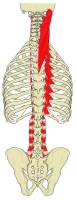 Splenius, levatores costarum and intertransversarii
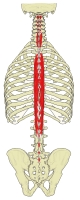 Spinalis and interspinales
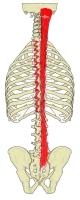 Transversospinalis
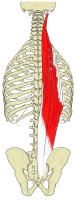 Erector spinae (iliocostalis and longissimus)
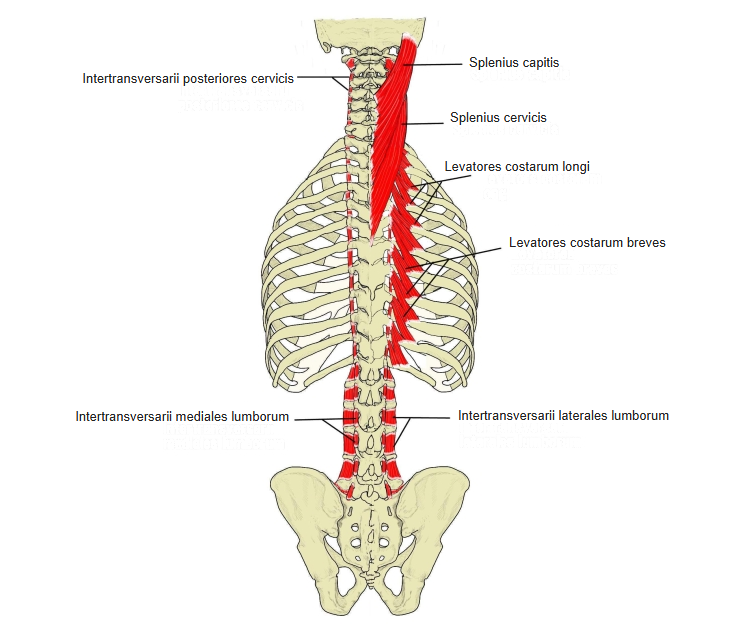
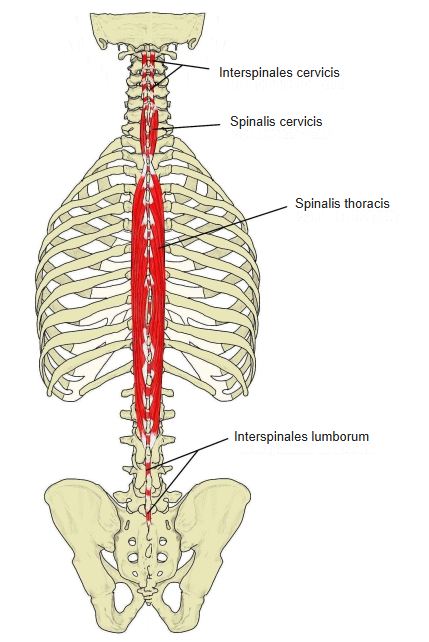
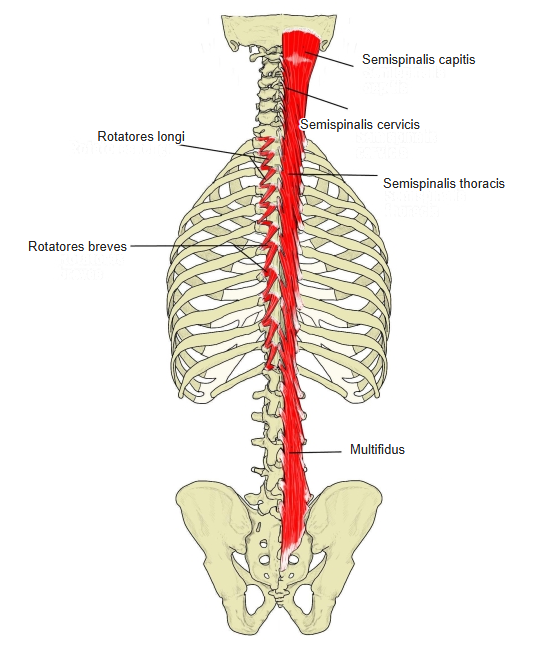
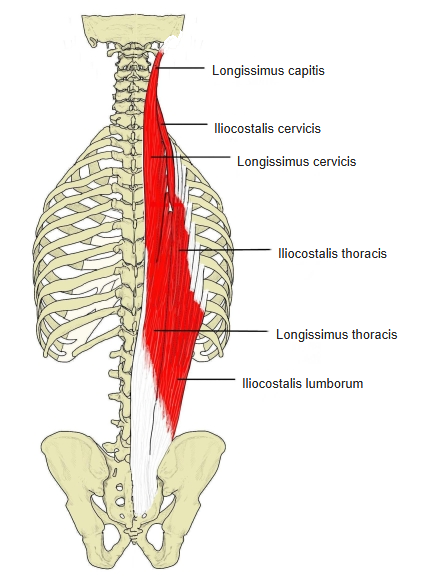
Why are they called "intrinsic"? A common explanation:
| Question | In anatomy, what are the intrinsic back muscles? |
| Answer | All the muscles lying in the back are "back muscles", but the trapezius (supplied by a cranial nerve, the accessory nerve), the latissimus dorsi (supplied from the brachial plexus) and the serratus posterior superior and inferior (supplied by the intercostal nerves) are supplied by anterior rami of the spinal nerves or by a cranial nerve: they did not belong to the back from the start but migrated there from the limbs or the neck. The muscles supplied by the posterior rami of the spinal nerves develop in the back itself (from the epaxial muscle mass) and stay there, so they are the back's own, "intrinsic" muscles. = the muscles supplied by the posterior rami of the spinal nerves |
By this rule the levatores costarum, which are supplied by the posterior rami (lateral branches) of C8–T11, count as intrinsic back muscles, as in the Prometheus table above; the grouping by nerve supply in point 1 places them between the ventral trunk muscles and the intrinsic back muscles because some books regard them as related to the ventral trunk muscles; sources differ. The four suboccipital muscles are supplied by the suboccipital nerve, which is itself the posterior ramus of C1, so they belong to them as well; many books count them as intrinsic back muscles, while some list them separately as the short nuchal muscles.
Related terms
- Transversospinalis muscles
- Spinalis
- Rotatores
- Interspinales muscles
- Splenius muscles
- Suboccipital muscles
- Thoracolumbar fascia
References and sources
- Further reading: Transversospinales, Wikipedia.
- Further reading: Erector spinae muscles, Wikipedia.
- Federative International Programme for Anatomical Terminology (FIPAT). Terminologia Anatomica, 2nd ed. (TA2), 2019.