Transversospinalis muscles (Latin: musculi transversospinales)
Also called the transversospinales
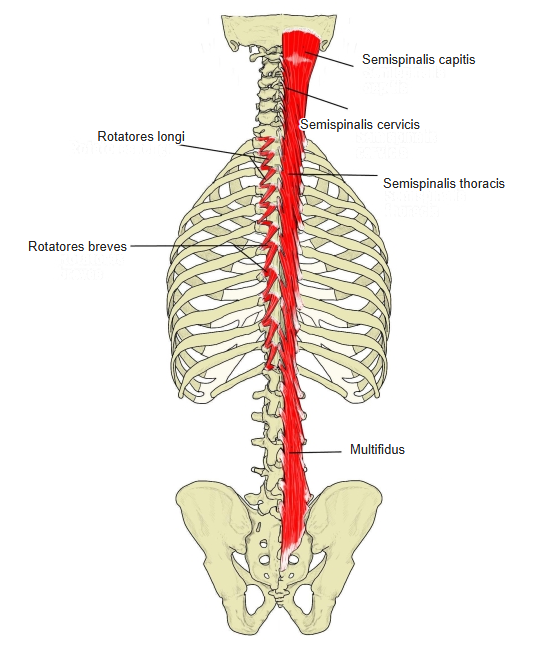
Of the deep back muscles of the back, the transversospinalis muscles are the three muscles of the intrinsic back muscles in the second layer: the semispinalis (most superficial), the multifidus and the rotatores (deepest).
All three basically arise from the transverse processes of the vertebrae and run upwards and medially to insert on the spinous processes.
They fill the groove beside the spinous processes, deep to the erector spinae. The semispinalis has three parts (capitis, cervicis and thoracis), and the rotatores are divided into longi and breves. The deeper the layer, the fewer vertebrae each bundle spans: semispinalis about 4 to 6, multifidus about 2 to 4, rotatores 1 or 2. Acting on both sides they extend the vertebral column (and, for semispinalis capitis, the head); acting on one side they bend it to that side and rotate it towards the opposite side. They also steady individual vertebrae. They are supplied by the posterior rami of the spinal nerves.
Muscles of the back (21)
- Superficial back muscles (5) : = spinohumeral muscles
- 1st layer (2)
- 2nd layer (3)
- Deep back muscles (16)
- 1st layer (2) : = spinocostal muscles
- 2nd layer (14)
- Muscles of the vertebral column (10) : = intrinsic back muscles, spinodorsal muscles
- Splenius muscles (2)
- Erector spinae (3)
- Transversospinalis muscles (3) : semispinalis, multifidus, rotatores
- Others (2)
- Suboccipital muscles (4)
- Muscles of the vertebral column (10) : = intrinsic back muscles, spinodorsal muscles
Related terms
- Semispinalis capitis
- Semispinalis cervicis
- Semispinalis thoracis
- Rotatores breves
- Spinous process
- Vertebral column
References and sources
- Further reading: Transversospinales, Wikipedia.
- Federative International Programme for Anatomical Terminology (FIPAT). Terminologia Anatomica, 2nd ed. (TA2), 2019.