Muscles of the back (Latin: musculi dorsi)
Also called: back muscles
The muscles on the back of the trunk, from the neck down to the lower back (and the pelvis). They can be divided into the superficial superficial muscles of the back and the deep muscles of the back below them.
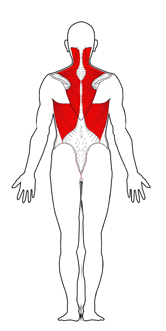
The back muscles of the most superficial layer.
of the
back
- Superficial muscles of the back : mostly from the spinous processes of the vertebrae to the bones of the upper limb
- Layer 1 : trapezius, latissimus dorsi
- Layer 2 : rhomboids (rhomboid major, rhomboid minor), levator scapulae
- Deep muscles of the back
- Layer 1 : serratus posterior superior, serratus posterior inferior
- Layer 2
- 1. Intrinsic back muscles : (muscles of the vertebral column): splenius capitis, splenius cervicis, erector spinae, transversospinales, interspinales, intertransversarii
- 2. Suboccipital muscles : rectus capitis posterior major, rectus capitis posterior minor, obliquus capitis inferior, obliquus capitis superior
The superficial back muscles attach to the bones of the upper limb (scapula, clavicle, humerus), move the upper limb and are supplied by anterior rami (the trapezius by the accessory nerve). The serratus posterior muscles are thin muscles running from the vertebral spines to the ribs. The intrinsic back muscles move the vertebral column and head and are supplied by posterior rami. Sources differ in grouping: many texts use three groups (superficial; intermediate = serratus posterior; deep = intrinsic), while others treat the serratus posterior muscles as the first layer of the deep group, as above. See also the muscles of the trunk.
Related terms
- Trapezius
- Latissimus dorsi
- Rhomboid major
- Levator scapulae
- Serratus posterior superior
- Transversospinalis muscles
- Vertebral column
References and sources
- Further reading: Human back, Wikipedia.
- Further reading: Erector spinae muscles, Wikipedia.
- Federative International Programme for Anatomical Terminology (FIPAT). Terminologia Anatomica, 2nd ed. (TA2), 2019.