Superficial muscles of the back
Also called: superficial back muscles; superficial extrinsic back muscles; spinohumeral muscles
· Most of them arise from the spinous processes of the vertebrae and act on the upper limb, especially through the shoulder girdle and the arm,
and for this reason they are also called the spinohumeral muscles. They lie in two layers.
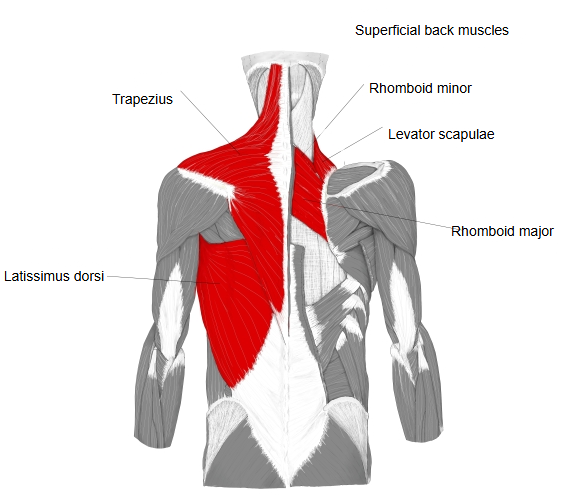
Besides the spinous processes, they arise from the nuchal ligament, the thoracolumbar fascia and nearby bone; the levator scapulae arises from the transverse processes of the upper cervical vertebrae. They insert on the scapula, clavicle or humerus, so they move the shoulder girdle and arm rather than the spine. Layer 1 is the trapezius and latissimus dorsi; layer 2, under the trapezius, is the rhomboid major, rhomboid minor and levator scapulae. Unlike the intrinsic back muscles, they are supplied by anterior rami or a cranial nerve: the trapezius by the accessory nerve, the latissimus dorsi by the thoracodorsal nerve, and the rhomboids and levator scapulae by the dorsal scapular nerve. Some texts count the two rhomboids as one muscle, giving four muscles instead of five. Sources also differ in grouping: many call these the superficial extrinsic back muscles and put the serratus posterior muscles in an intermediate group; others place the serratus posterior muscles in the first layer of the deep back muscles, as in the tree below. See also muscles of the back.
of the
back (21)
- Superficial muscles of the back (5) : = spinohumeral muscles
- Layer 1 (2) : trapezius, latissimus dorsi
- Layer 2 (3) : rhomboid major, rhomboid minor, levator scapulae
- Deep muscles of the back (16)
- Layer 1 (2) : serratus posterior superior, serratus posterior inferior
- Layer 2 (14)
- Muscles of the vertebral column (10) : = intrinsic back muscles
- Splenius (2)
- Erector spinae (3)
- Transversospinales (3)
- Others (2) : interspinales, intertransversarii
- Suboccipital muscles (4)
- Muscles of the vertebral column (10) : = intrinsic back muscles
Related terms
- Muscles of the back
- Intrinsic back muscles
- Trapezius
- Latissimus dorsi
- Rhomboid major
- Rhomboid minor
- Levator scapulae
References and sources
- Further reading: Human back, Wikipedia.
- Federative International Programme for Anatomical Terminology (FIPAT). Terminologia Anatomica, 2nd ed. (TA2), 2019.