Glisson's capsule (Latin: tunica fibrosa hepatis)
Also called Fibrous capsule of liver
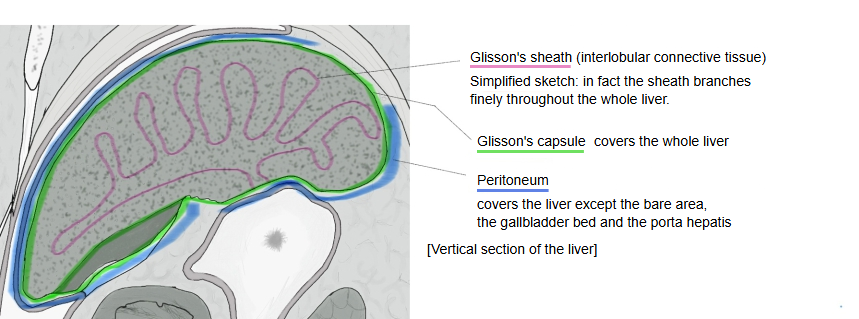
· Except in a few places (the porta hepatis, the bare area and the area in contact with the gallbladder), the outside of Glisson's capsule is covered by the peritoneum (visceral peritoneum).
and its
membranes
- Surface
- Glisson's capsule : a membrane of connective tissue that covers the whole surface; it contains a few cells, nerves and small vessels.
- Peritoneum : covers the surface except a few parts (the porta hepatis, the bare area and the area in contact with the gallbladder); a serous membrane.
- Liver substance
- Glisson's sheath : the continuation of Glisson's capsule; from the porta hepatis it wraps the arteries, veins and bile ducts together (portal triad) and follows them into the liver as the interlobular connective tissue.
The surface of the liver is covered by peritoneum everywhere except where the back of its diaphragmatic surface touches the diaphragm directly (the bare area), where its visceral surface touches the gallbladder, and at the porta hepatis. Under this peritoneum (a serous membrane) lies a thin but strong layer of connective tissue, rich in collagen and elastic fibres, that covers the whole liver substance: this is Glisson's capsule (fibrous capsule of the liver, a kind of organ capsule). Where there is no peritoneum, the capsule itself forms the surface. Stretching of the capsule, for example when the liver swells, is felt as pain; the liver tissue itself is not sensitive to pain. Sources differ in naming: in the official terminology the eponym belongs to the perivascular fibrous capsule, the inner sheath around the portal triad.
Related terms
- Liver
- Porta hepatis
- Bare area
- Visceral peritoneum
- Portal triad
- Interlobular connective tissue
- Gallbladder
References and sources
- Further reading: Liver, Wikipedia.
- Further reading: Portal triad, Wikipedia.
- Federative International Programme for Anatomical Terminology (FIPAT). Terminologia Anatomica, 2nd ed. (TA2), 2019.