Pelvic fascia (Latin: fascia pelvis)
Also called the endopelvic fascia (in some sources)
· It is a widely used name (Latin: fascia pelvis). Sources differ in their use of the name endopelvic fascia: some use it for the whole pelvic fascia, others only for the visceral part or for the loose tissue between the organs.
Fascia: it used to be thought of as "a membrane that wraps a muscle", but today it is generally regarded as "a sheet-like structure of connective tissue".
So the name is used even where the tissue has nothing to do with a muscle.
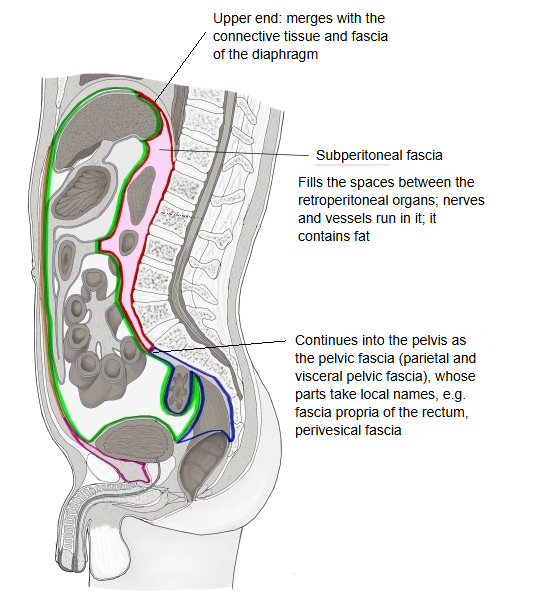
- Pelvic fascia : continues from the subperitoneal fascia near the pelvic inlet.
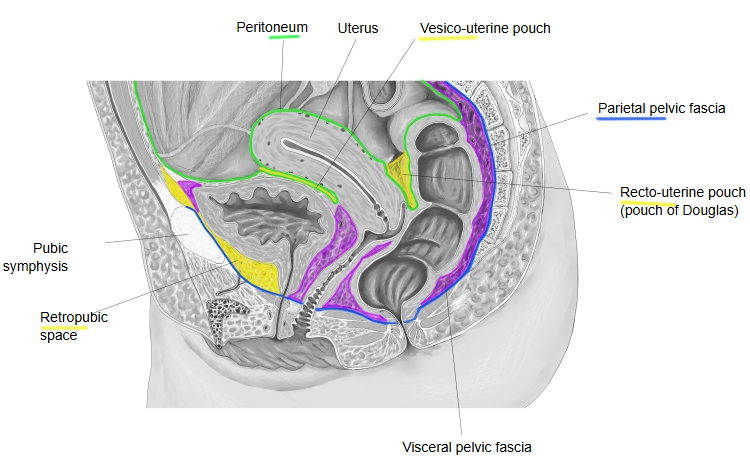
- Parietal pelvic fascia : the fascia covering the pelvic wall (obturator internus, piriformis and others) + the presacral fascia.
- Visceral pelvic fascia : covers the surfaces of the pelvic organs and forms the connective tissue between them, a pathway for nerves and vessels. Its parts take the names of their organs, e.g. the fascia propria of the rectum, the vesical fascia and the prostatic fascia.
The pelvic fascia fills the spaces below the peritoneum of the pelvic cavity, with fat, vessels and nerves. The parietal layer includes the obturator fascia, on which the tendinous arch of levator ani is formed, and the fascia of the pelvic floor; above, it is continuous with the transversalis fascia of the abdominal wall. The visceral layer includes the fascia propria of the rectum around the mesorectum and, in the female, the cardinal ligament.
Related terms
- Pelvic cavity
- Superior pelvic aperture
- Visceral pelvic fascia
- Parietal pelvic fascia
- Subperitoneal fascia
- Fascia
- Obturator fascia
- Tendinous arch of levator ani
- Mesorectum
- Transversalis fascia
References and sources
- Further reading: Pelvic fascia, Wikipedia.
- Further reading: Endopelvic fascia, Wikipedia.
- Federative International Programme for Anatomical Terminology (FIPAT). Terminologia Anatomica, 2nd ed. (TA2), 2019.