Secondary spiral lamina (Latin: lamina spiralis secundaria)
It arises from the outer wall of the spiral canal of the cochlea in the lower half of the basal turn and lies opposite the osseous spiral lamina. It is much smaller than the osseous spiral lamina and does not reach it, so a narrow slit remains between the two laminae; in the lowest part of the basal turn the basilar membrane stretches across this gap. It lies between the scala tympani below and the cochlear duct and scala vestibuli above, and fades out higher in the cochlea, where the outer attachment of the basilar membrane is the spiral ligament.
- Spiral canal of the cochlea : total length about 3 cm; 2.5–2.75 turns.
- Upper level: Scala vestibuli : filled with perilymph; passes the sound vibrations to the cochlear duct; part of the bony labyrinth. It joins the scala tympani at the helicotrema.
- Vestibular (Reissner's) membrane : between the scala vestibuli and the cochlear duct.
- Cochlear duct : filled with endolymph; holds the spiral organ; both ends are closed. Contents of the duct region: basilar membrane, organ of Corti, internal and external spiral sulci, spiral prominence, stria vascularis, tectorial membrane.
- Osseous spiral lamina + basilar membrane : (+ secondary spiral lamina) between the cochlear duct and the scala tympani.
- Lower level: Scala tympani : part of the bony labyrinth, filled with perilymph; the travelling wave passes on into it.
- Modiolus : the cone of spongy bone at the centre of the cochlea, with the longitudinal canals and the spiral canal of the modiolus.
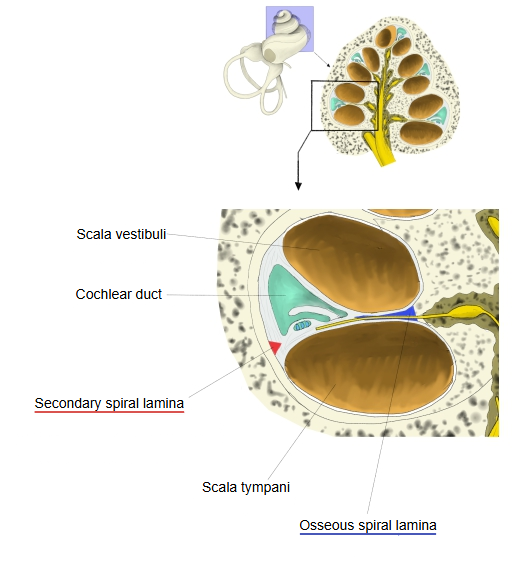
The shape, position and size of the secondary spiral lamina in the figure are approximate.
Reference websites
[Wikipedia]
· Cochlea, Wikipedia.
[Websites with illustrations]
· Section of the cochlea (Sobotta, 1911) (Wikimedia Commons)

Related terms
- Osseous spiral lamina
- Basilar membrane
- Scala tympani
- Scala vestibuli
- Hamulus of spiral lamina
- Modiolus
- Cochlea
References and sources
- Further reading: Cochlea, Wikipedia.
- Federative International Programme for Anatomical Terminology (FIPAT). Terminologia Anatomica, 2nd ed. (TA2), 2019.