Semilunar hiatus (Latin: hiatus semilunaris)
· Beside the uncinate process a curved, slit-like space is left that surrounds the ethmoidal bulla from the front and below: this is the semilunar hiatus. It is a crescent-shaped groove in the lateral wall of the middle nasal meatus, bounded above and behind by the bulla and below and in front by the sharp, concave free edge of the uncinate process. It lies under cover of the middle nasal concha, which has to be lifted or removed to see it.
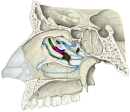 Right nasal cavity, lateral wall (conchae cut)
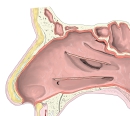 Right nasal cavity, lateral wall (mucosa)
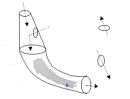 Ethmoidal infundibulum (schematic)
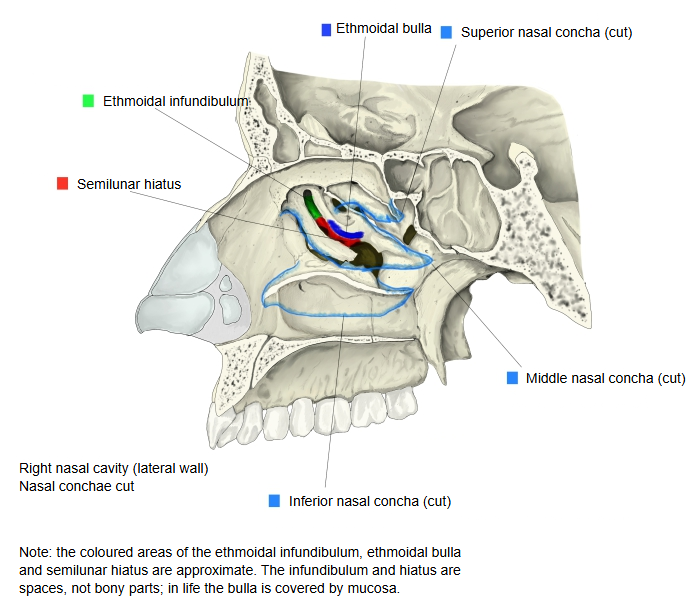
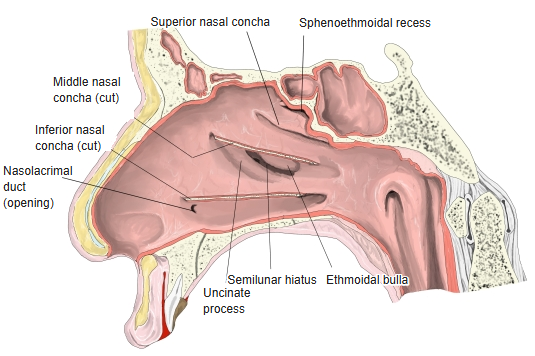
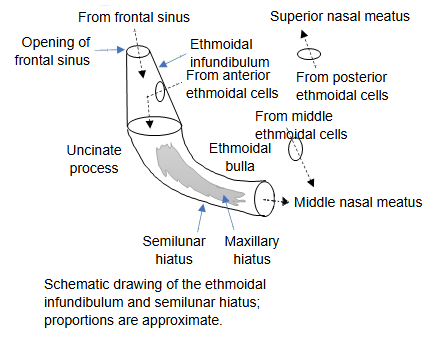
Above the uncinate process and parallel to it lies the ethmoidal bulla, the most conspicuous of the anterior ethmoidal air cells because of its position and size; its shape varies greatly. Between the bulla and the uncinate process lies the sickle-shaped semilunar hiatus. On the dried skull several gaps lead into the maxillary sinus, where the uncinate process and nearby bones narrow the wide maxillary hiatus; once the soft parts are in place, the semilunar hiatus is the only one left. It is the opening into the nasal cavity of the funnel-shaped ethmoidal infundibulum, which links the nasal cavity with the maxillary sinus. The infundibulum is completed only by the lining mucosa, so it is not seen as a closed channel on the dried skull. The frontal sinus opens into the middle nasal meatus by way of the semilunar hiatus, either into the infundibulum or, in about half of people, in front of it. The anterior ethmoidal cells also open into the middle meatus, while the posterior cells open into the superior nasal meatus.
Sinus drainage
Traced forward and upward along its curve, the hiatus leads into the ethmoidal infundibulum, which receives the openings of the anterior ethmoidal cells and often the frontonasal duct of the frontal sinus. When the front end of the uncinate process fuses with the front of the bulla, this connection is interrupted and the frontal sinus drains directly into the front end of the middle meatus; sources differ on how often each pattern occurs. The opening of the maxillary sinus lies at the back of the hiatus and is the largest opening in it. Surgeons include this region in the ostiomeatal complex.
Reference websites
[Wikipedia]
· Semilunar hiatus, Wikipedia.
[Websites with illustrations]
· The paranasal sinuses (TeachMeAnatomy)
· The nasal cavity (TeachMeAnatomy)
· Nasal cavity (Kenhub)
Related terms
- Ethmoidal bulla
- Uncinate process
- Middle nasal meatus
- Maxillary hiatus
- Maxillary sinus
- Ethmoidal air cells
- Frontal sinus
References and sources
- Further reading: Semilunar hiatus, Wikipedia.
- Further reading: Ostiomeatal complex, Wikipedia.
- Federative International Programme for Anatomical Terminology (FIPAT). Terminologia Anatomica, 2nd ed. (TA2), 2019.