Suprameatal pit (Latin: foveola suprameatica)
Also called the suprameatal triangle
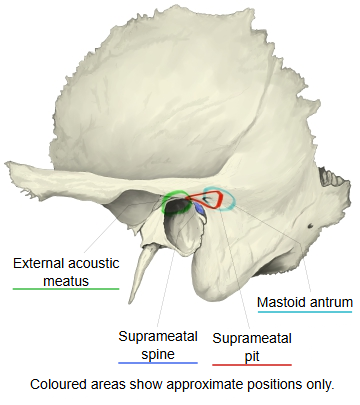
· The mastoid antrum lies about 1.5–2 cm deep to the suprameatal pit in adults, so the pit is the surface guide for inserting instruments to reach the antrum in mastoid surgery (mastoidectomy). The antrum opens into the mastoid air cells of the mastoid process.
· It is a depression above the suprameatal spine, lateral to the mastoid antrum. It is bounded above by the supramastoid crest (the backward continuation of the posterior root of the zygomatic process), in front and below by the upper and back margin of the external acoustic meatus, and behind by a vertical line touching the back of the meatus. The suprameatal spine, when present, lies at its front lower corner.
It is also called Macewen's triangle. On the living head it lies under the cymba conchae of the auricle, so the cymba conchae is its surface marking.
Reference websites
[Wikipedia]
· Suprameatal triangle, Wikipedia.
· Mastoid antrum, Wikipedia.
[Websites with illustrations]
· Macewen's suprameatal triangle, landmark of the mastoid antrum (Wikimedia Commons)

· Left temporal bone, outer surface (Gray's Anatomy, fig. 137) (Wikimedia Commons)

Related terms
- Suprameatal spine
- External acoustic opening
- External acoustic meatus
- Zygomatic process
- Mastoid process
- Mastoid cells
- Squamous part
- Temporal bone
References and sources
- Further reading: Suprameatal triangle, Wikipedia.
- Further reading: Mastoid antrum, Wikipedia.
- Federative International Programme for Anatomical Terminology (FIPAT). Terminologia Anatomica, 2nd ed. (TA2), 2019.