Suprameatal spine (Latin: spina suprameatica)
Also called the spine of Henle
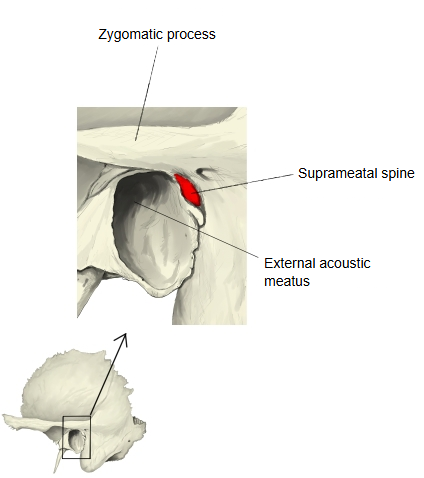
The suprameatal spine is a small, pointed bony process next to the entrance of the upper wall of the external acoustic meatus, at the upper and back edge of the external acoustic opening; the name is used when this process is clearly present.
External acoustic meatus: the canal that leads from the external acoustic opening to the tympanic membrane
It lies just below the posterior root of the zygomatic process, on the squamous part of the temporal bone. It is not always present, and its size varies. It is also called the spine of Henle.
Just above and behind it lies the suprameatal pit (suprameatal triangle), the surface guide to the mastoid antrum, which lies about 1.5 cm deep. The spine is therefore a landmark in ear and mastoid surgery.
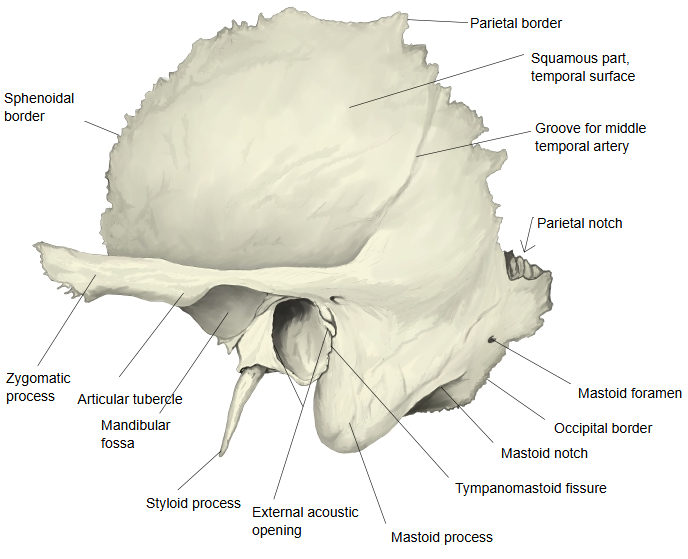
- Squamous part : the middle and upper part of the bone, with two surfaces: the temporal (outer) surface and the cerebral (inner) surface. Related terms: groove for the middle temporal artery, zygomatic process (articular tubercle), suprameatal spine.
- Petrous part : the part below and behind the squamous part, reaching medially into the base of the skull, in two parts: the mastoid part (from the mastoid process to the parietal notch) and the pyramid, which forms part of the cranial base.
- Tympanic part : the smallest part: a curved, thin plate of bone that forms the front wall and the floor of the external acoustic meatus.
 Around the external acoustic opening
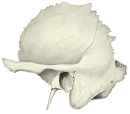 Temporal bone (lateral view), labelled
Reference websites
[Wikipedia]
· Suprameatal spine, Wikipedia.
· Temporal bone, Wikipedia.
[Websites with illustrations]
· Temporal bone, lateral view, with the suprameatal spine labelled (figure) (Ento Key)
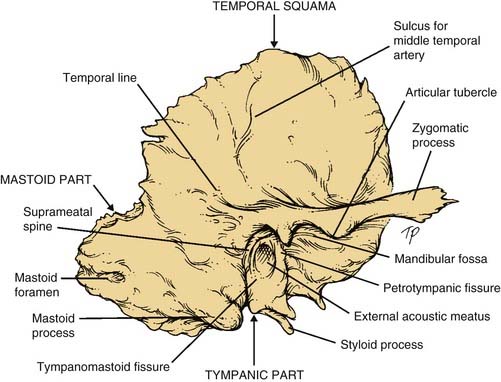
· Left temporal bone, outer surface (Gray's Anatomy, fig. 137) (Wikimedia Commons)

Related terms
- Suprameatal pit
- External acoustic opening
- External acoustic meatus
- Zygomatic process
- Squamous part
- Mastoid process
- Tympanic part
- Temporal bone
References and sources
- Further reading: Suprameatal spine, Wikipedia.
- Further reading: Temporal bone, Wikipedia.
- Federative International Programme for Anatomical Terminology (FIPAT). Terminologia Anatomica, 2nd ed. (TA2), 2019.