External acoustic opening (Latin: Porus acusticus externus)
Also called the external acoustic pore or the external auditory opening
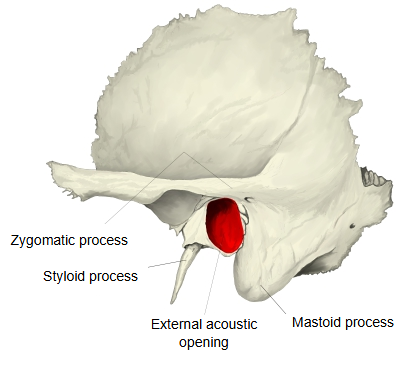
Position: below the root of the zygomatic process, in front of and above the mastoid process.
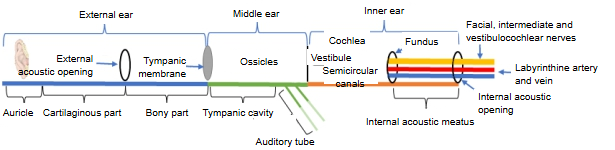
The external acoustic opening is part of the external ear: in life it marks the boundary between the cartilaginous part (outer third) and the bony part (inner two-thirds) of the external acoustic meatus. Its rim is formed mostly by the tympanic part of the temporal bone, with the squamous part above. Sources differ: in clinical use the same name is sometimes given to the entrance of the ear canal at the auricle. The tympanic membrane closes the inner end of the canal; the opening of the canal on the inside of the skull, for the nerves of the inner ear, is the internal acoustic meatus.
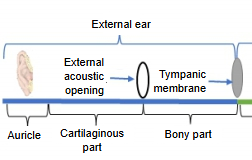
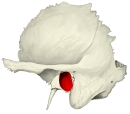 Left temporal bone (lateral view)
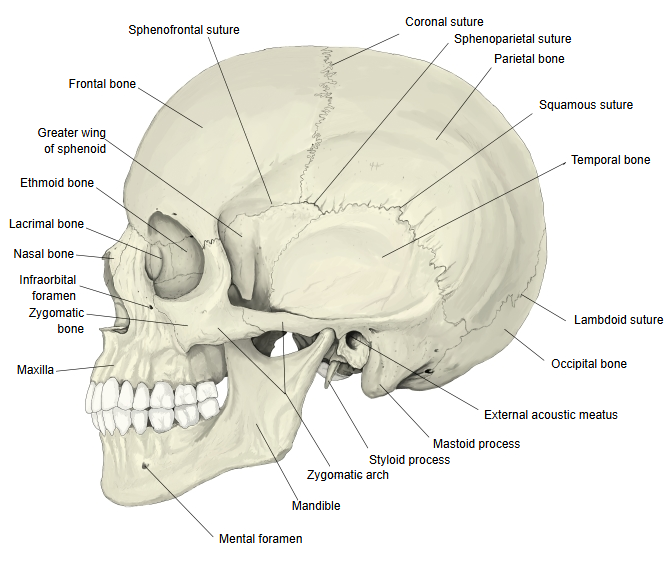
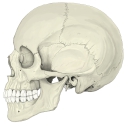 Skull (left lateral view)
 Hearing: model diagram
Reference websites
[Wikipedia]
· Ear canal, Wikipedia.
· Temporal bone, Wikipedia.
[Websites with illustrations]
· The external ear (TeachMeAnatomy)
· Ear anatomy: parts and functions (Kenhub)
Related terms
- External acoustic meatus
- External ear
- Tympanic membrane
- Mastoid process
- Zygomatic process
- Internal acoustic meatus
- Auricle
References and sources
- Further reading: Ear canal, Wikipedia.
- Further reading: Temporal bone, Wikipedia.
- Federative International Programme for Anatomical Terminology (FIPAT). Terminologia Anatomica, 2nd ed. (TA2), 2019.