Ventral body cavity
Also called the ventral cavity
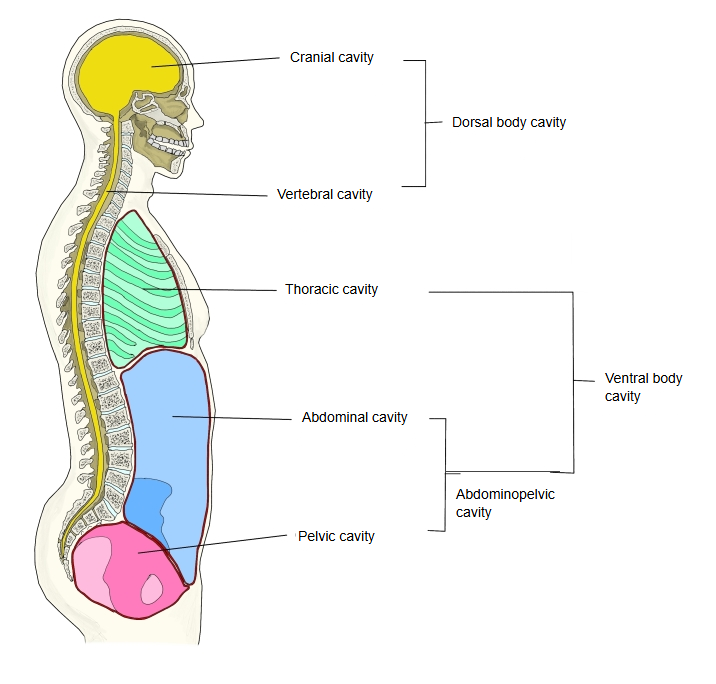
· The diaphragm separates the thoracic cavity above from the abdominopelvic cavity below.
· The thoracic cavity holds the pleural cavities and the mediastinum (with the pericardial cavity); the abdominal cavity and the pelvic cavity (within the pelvis) below are continuous with each other, and the peritoneal cavity lies within them. The thoracic cavity is the space inside the thorax.
· Most of its organs are wrapped in serous membranes (pleura, serous pericardium, peritoneum), which let them slide against each other and the walls.
· Its counterpart is the dorsal body cavity, made up of the cranial cavity and the vertebral canal.
Note: the division into dorsal and ventral body cavities is a teaching scheme used mainly in introductory textbooks. It is not part of Terminologia Anatomica, and sources differ on whether the dorsal cavity should count as a body cavity at all.
Reference websites
· Illustration: dorsal and ventral body cavities (Wikimedia Commons)

· Illustration: body cavities, midsagittal and coronal views (Biology Corner)

Related terms
References and sources
- Further reading: Body cavity, Wikipedia.
- Federative International Programme for Anatomical Terminology (FIPAT). Terminologia Anatomica, 2nd ed. (TA2), 2019.