Maxillary tuberosity (Latin: tuber maxillae)
Also called the maxillary eminence
· It is a blunt, rough swelling that bulges backwards, pierced by two or three small foramina. It lies just above the alveolar process and becomes more prominent after the third molar (wisdom tooth) has erupted.
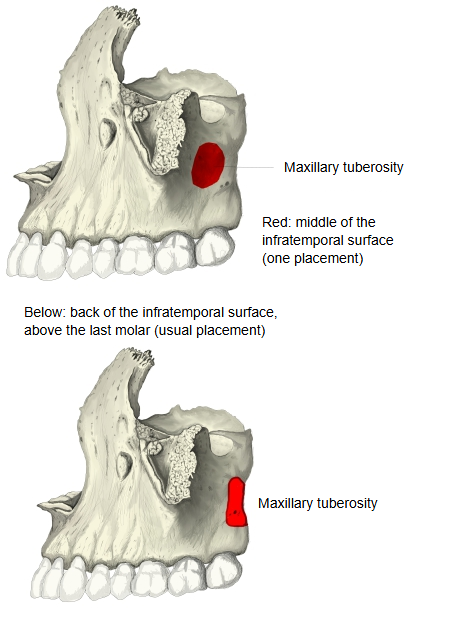
Question: the two or three small foramina are the alveolar foramina, which lead into the posterior alveolar canals for the posterior superior alveolar nerves and vessels. If the tuberosity is taken to be the area that carries them, its position is a little further back than the area marked in red in the first figure below. Sources differ on its exact extent, but most English texts describe it as the posterior, lower part of the infratemporal surface above the last molar.
English Wikipedia gives the maxillary tuberosity as one origin of the superficial head of the medial pterygoid, whereas some textbooks give only the pterygoid process of the sphenoid bone as its origin. A few fibres of the superficial head do arise from the tuberosity; sources differ on how much of the origin is on the maxilla. Medially the tuberosity is rough where it meets the pyramidal process of the palatine bone; it sometimes also meets the lateral pterygoid plate of the sphenoid.
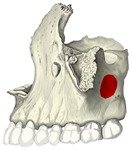 Maxillary tuberosity: two placements
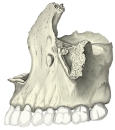 Maxilla (lateral view)
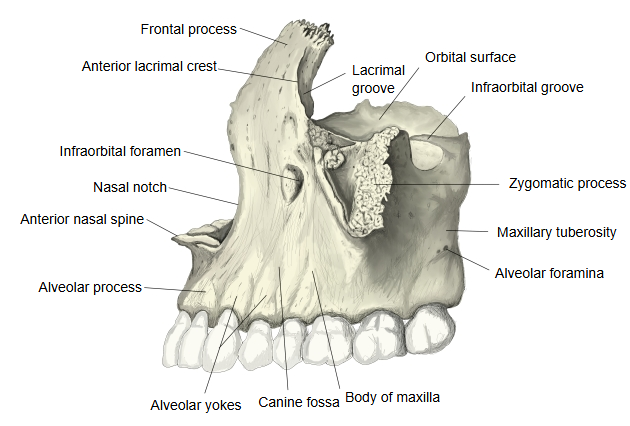
Reference websites
[Wikipedia]
· Maxillary tuberosity, Wikipedia.
· Maxilla, Wikipedia.
Where it is found
Related terms
- Body of maxilla
- Alveolar process
- Zygomatic process
- Pyramidal process
- Infraorbital foramen
- Maxillary sinus
References and sources
- Further reading: Maxillary tuberosity, Wikipedia.
- Further reading: Maxilla, Wikipedia.
- Federative International Programme for Anatomical Terminology (FIPAT). Terminologia Anatomica, 2nd ed. (TA2), 2019.