Abdominopelvic cavity (Latin: cavitas abdominis et pelvis)
Also called the abdominal and pelvic cavity
cavities
- Dorsal cavity
- Cranial cavity : main organ: brain; membranes: meninges.
- Vertebral cavity : main organ: spinal cord; membranes: meninges.
- Ventral cavity
- Thoracic cavity
- Right and left pulmonary regions : main organs: the lungs (each in its pleural sac).
- Mediastinum : superior: aortic arch, trachea, oesophagus, thoracic duct and others; inferior: heart (in the pericardial cavity), ascending aorta and others.
- Abdominopelvic cavity
- Abdominal cavity : main organs: digestive organs, spleen, kidneys; membrane: peritoneum.
- Pelvic cavity : main organs: urinary bladder, reproductive organs; membrane: peritoneum.
- Thoracic cavity
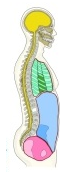 Body cavities (lateral)
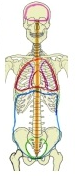 Body cavities (anterior)
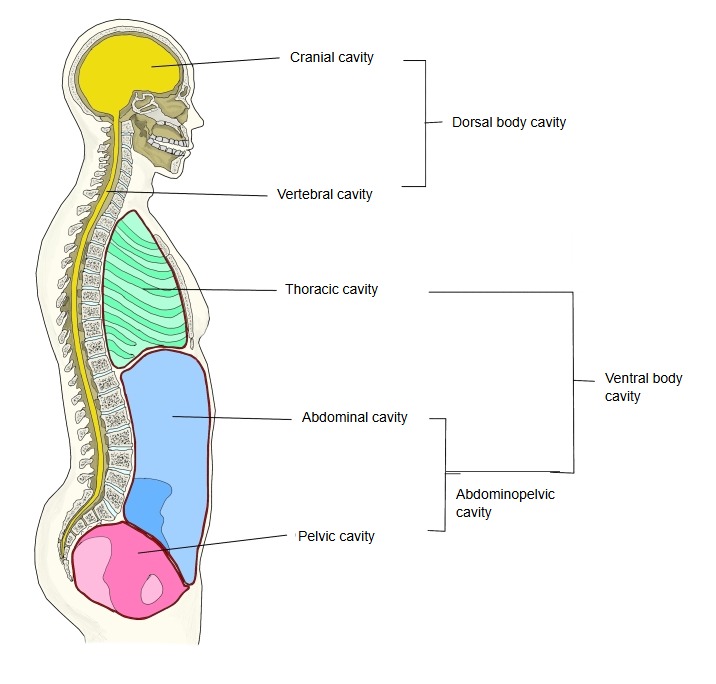
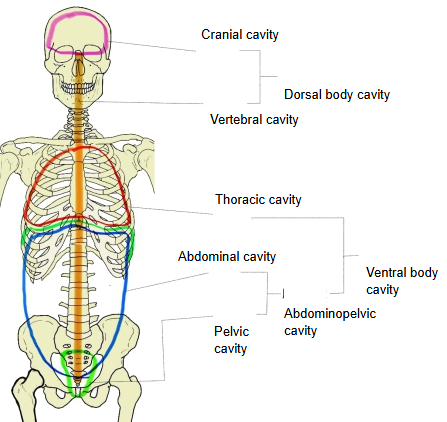
The abdominopelvic cavity holds most of the digestive organs, the spleen, the kidneys, the urinary bladder and the internal reproductive organs. The abdominal cavity contains the digestive organs, the spleen, the kidneys and the suprarenal glands and is lined by peritoneum; the pelvic cavity contains the urinary bladder, the rectum and the internal reproductive organs, and the peritoneum covers only its upper part.
It is lined by parietal peritoneum; the narrow peritoneal cavity lies inside it, between the parietal and visceral peritoneum (see Peritoneum).
There is no wall between the abdominal and pelvic cavities. The boundary is usually taken as the plane of the pelvic inlet (pelvic brim) of the pelvis.
Together with the thoracic cavity of the thorax it forms the ventral body cavity; the two are separated by the diaphragm. The division into dorsal and ventral body cavities is common in introductory textbooks but is not part of Terminologia Anatomica; sources differ in how they use it.
Related terms
References and sources
- Further reading: Abdominopelvic cavity, Wikipedia.
- Further reading: Body cavity, Wikipedia.
- Federative International Programme for Anatomical Terminology (FIPAT). Terminologia Anatomica, 2nd ed. (TA2), 2019.