Splenius muscles (Latin: musculi splenii)
What are the splenius muscles?
In the diagram below, splenius capitis and splenius cervicis are grouped together in a category of their own, the splenius muscles.
muscles
(21)
- Superficial back muscles (5) : = spinohumeral muscles
- 1st layer (2)
- 2nd layer (3)
- Deep back muscles (16)
- 1st layer (2) : = spinocostal muscles
- 2nd layer (14)
- Muscles of the vertebral column (10) : = intrinsic back muscles
- Splenius muscles (2) : splenius capitis, splenius cervicis
- Erector spinae (3)
- Transversospinalis (3)
- Others (2)
- Suboccipital muscles (4)
- Muscles of the vertebral column (10) : = intrinsic back muscles
By their course and attachments the splenius is divided into splenius capitis and splenius cervicis, although their origins are not sharply separated. Both arise from the lower part of the nuchal ligament and the spinous processes of C7 and the upper thoracic vertebrae (sources differ slightly on the lowest level), and run upward and laterally. Splenius capitis inserts on the mastoid process and the lateral part of the superior nuchal line of the occipital bone; splenius cervicis inserts on the transverse processes of the upper cervical vertebrae (C1 to C3). Both sides together extend the head and neck; one side alone bends the neck to that side and turns the head to the same side. They form the most superficial layer of the intrinsic back muscles in the neck, under the trapezius, the rhomboids and the serratus posterior superior, and like a bandage they cover the deeper neck muscles: the semispinalis capitis, the longissimus capitis and the suboccipital muscles. Nerve supply: the posterior rami of the cervical spinal nerves.
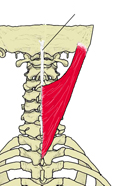 Splenius capitis (right side)
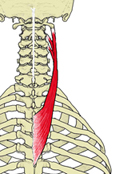 Splenius cervicis (right side)
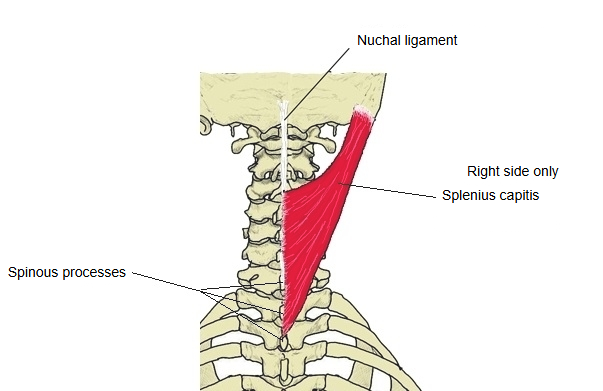
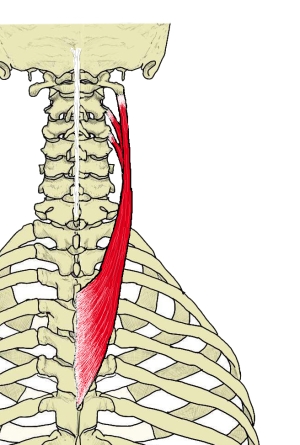
Related terms
References and sources
- Further reading: Splenius capitis muscle, Wikipedia.
- Further reading: Splenius cervicis muscle, Wikipedia.
- Federative International Programme for Anatomical Terminology (FIPAT). Terminologia Anatomica, 2nd ed. (TA2), 2019.