Spinocostal muscles (Latin: musculi spinocostales)
Also called: serratus posterior muscles
- Superficial back muscles (5) : the spinohumeral muscles. First layer (2): trapezius, latissimus dorsi. Second layer (3): rhomboid major, rhomboid minor, levator scapulae.
- Deep back muscles (16)
- First layer (2) : the spinocostal muscles: serratus posterior superior and inferior.
- Second layer (14)
- Muscles of the vertebral column (10) : the intrinsic back muscles: splenius muscles (2), erector spinae (3), transversospinalis muscles (3), others (2: interspinales, intertransversarii).
- Suboccipital muscles (4) : rectus capitis posterior major and minor, obliquus capitis superior and inferior.
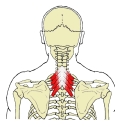 Serratus posterior superior
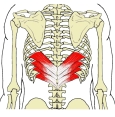 Serratus posterior inferior
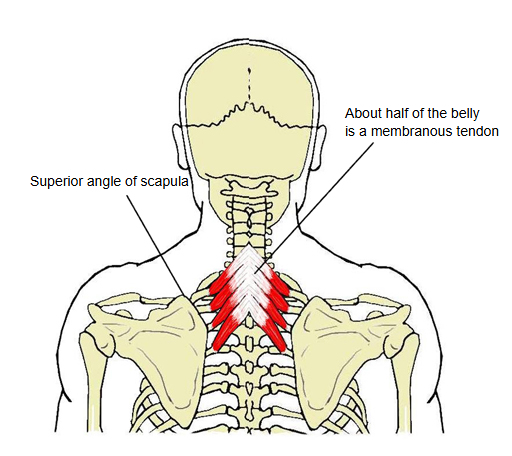
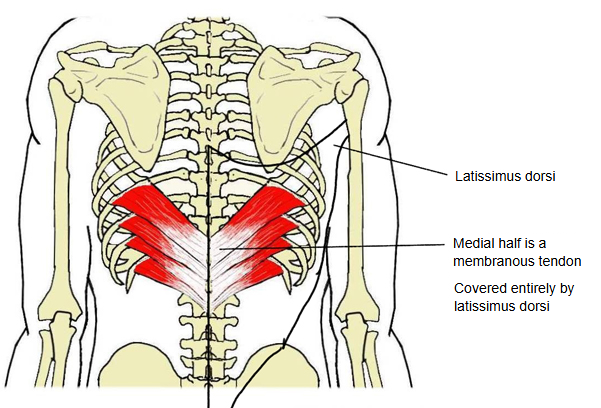
The spinocostal muscles are thin muscles of the back that run from the spinous processes of the vertebrae to the ribs. They lie in an intermediate position: under the superficial back muscles (the spinohumeral muscles, which join the trunk to the upper limb) and over the intrinsic back muscles. Many texts call them the intermediate layer of the back; some count them as the first layer of the deep back muscles, as here.
The serratus posterior superior runs from the lower cervical and upper thoracic spinous processes to the 2nd–5th ribs, under the rhomboids; the serratus posterior inferior runs from the lower thoracic and upper lumbar spinous processes, through the thoracolumbar fascia, to the 9th–12th ribs, under the latissimus dorsi. The medial part of each is a thin aponeurosis. Both are supplied by intercostal nerves (anterior rami), not by posterior rami, so they are not true intrinsic back muscles. They are usually described as accessory muscles of breathing (the superior one raising and the inferior one lowering the ribs), but their real role is uncertain.
Related terms
- Serratus posterior superior
- Serratus posterior inferior
- Muscles of the back
- Latissimus dorsi
- Splenius muscles
- Ribs
- Spinous process
References and sources
- Further reading: Serratus posterior superior muscle, Wikipedia.
- Further reading: Serratus posterior inferior muscle, Wikipedia.
- Federative International Programme for Anatomical Terminology (FIPAT). Terminologia Anatomica, 2nd ed. (TA2), 2019.