Endolymph (Latin: endolympha)
Also called Scarpa's fluid
· Outside the membranous labyrinth, the space between it and the bony labyrinth is filled with perilymph.
· Endolymph and perilymph do not communicate or mix.
· Unlike most extracellular fluids, endolymph is high in potassium and low in sodium: its main cation is potassium.
(The potassium ions are secreted by the stria vascularis.)
· Also called "Scarpa's fluid".
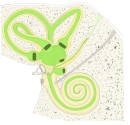 Bony and membranous labyrinth
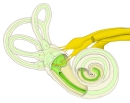 Labyrinth of the inner ear
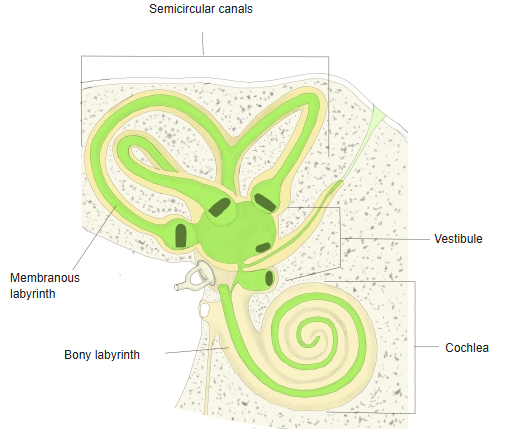
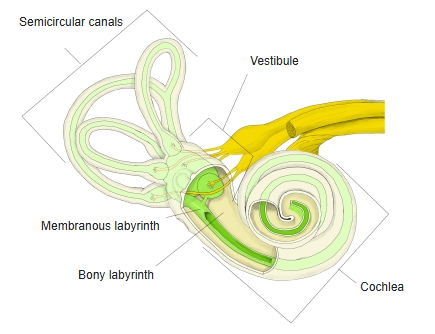
| Name | Description | |
| 1 | Perilymph | · Lies between the bony labyrinth and the membranous labyrinth: in the scala vestibuli and scala tympani of the cochlea and in the spaces around the utricle, saccule and semicircular ducts. · Communicates with the cerebrospinal fluid through the perilymphatic duct. · Ions: high in sodium, low in potassium (similar to plasma and cerebrospinal fluid). |
| 2 | Endolymph | · Lies inside the membranous labyrinth. · Ions: mainly potassium, low in sodium. |
Structure
The internal ear has two parts: the bony labyrinth and the membranous labyrinth, which lies inside it. Endolymph fills the membranous labyrinth: the cochlear duct, the utricle, the saccule and the semicircular ducts. Perilymph lies between the outer wall of the membranous labyrinth and the wall of the bony labyrinth. Endolymph drains through the endolymphatic duct to the endolymphatic sac.
Function
Hearing: in the cochlear duct, sound produces fluid waves in the endolymph that move the receptor (hair) cells, which turn this movement into nerve impulses perceived as sound. In the cochlea the endolymph is about +80 mV relative to the perilymph (the endocochlear potential); this drives potassium into the hair cells when their hair bundles are deflected.
Balance: when the head rotates, the endolymph in the semicircular ducts lags behind and flows relative to the duct walls, stimulating the vestibular receptor cells. The semicircular ducts of both ears work together to keep the balance.
Reference websites
[Wikipedia]
· Endolymph, Wikipedia.
· Perilymph, Wikipedia.
· Membranous labyrinth, Wikipedia.
Related terms
- Space of Nuel
- Perilymph
- Endolymphatic space
- Endolymphatic duct
- Endolymphatic sac
- Stria vascularis
- Scala media
- Labyrinth
References and sources
- Further reading: Endolymph, Wikipedia.
- Further reading: Membranous labyrinth, Wikipedia.
- Federative International Programme for Anatomical Terminology (FIPAT). Terminologia Anatomica, 2nd ed. (TA2), 2019.