Biarticular muscle
Also called Two-joint muscle
A skeletal muscle whose origin and insertion lie across two joints, such as the muscles below.
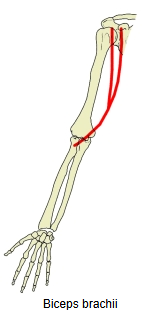
| Upper limb | 1 | Biceps brachii | Elbow joint and shoulder joint (glenohumeral joint) |
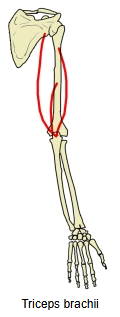
| 2 | Triceps brachii (long head) | Elbow joint and shoulder joint | |
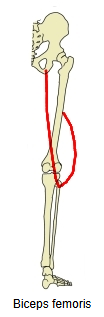
| Lower limb | 3 | Biceps femoris (long head) | Hip joint and knee joint |
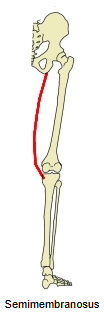
| 4 | Semimembranosus | Hip joint and knee joint | |
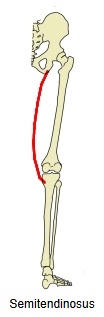
| 5 | Semitendinosus | Hip joint and knee joint | |
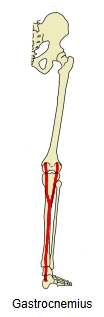
| 6 | Gastrocnemius | Knee joint and talocrural (ankle) joint | |
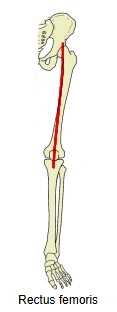
| 7 | Rectus femoris | Hip joint and knee joint |
Other examples are sartorius and gracilis (hip and knee). The long head of biceps femoris, semimembranosus and semitendinosus are the hamstrings. Because a biarticular muscle spans two joints, the position of one joint changes how well it can act on the other; this links the movements of neighbouring joints, for example in walking.
Below are schematic drawings of the biarticular muscles; the courses of the muscles are not exact.
Related terms
References and sources
- Further reading: Biarticular muscle, Wikipedia.
- Federative International Programme for Anatomical Terminology (FIPAT). Terminologia Anatomica, 2nd ed. (TA2), 2019.