Condyle (Latin: condylus)
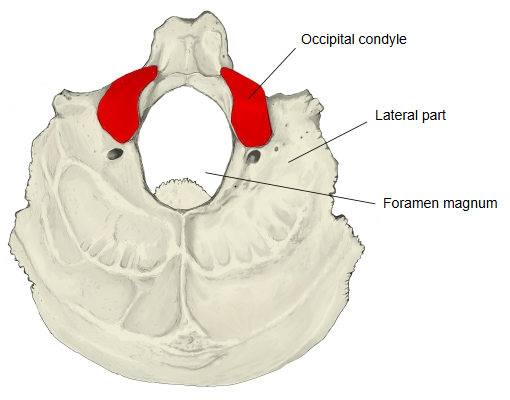
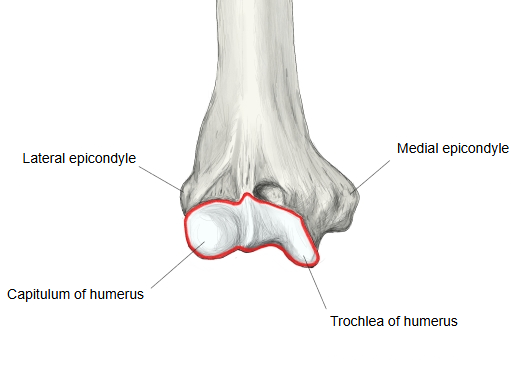
Examples are the medial and lateral condyles of the femur and the medial and lateral condyles of the tibia at the knee joint; the occipital condyles, on which the skull rests on the atlas; the condyle of the humerus at the elbow joint; and the condyle of the mandible (the condylar process) at the temporomandibular joint.
The condyles of the femur are two large rounded masses at the lower end of the bone. The condyles of the tibia are the expanded upper end of the bone; their upper surfaces bear the superior articular surface on which the femoral condyles rest.
A condyle should not be confused with an epicondyle, a projection on or above a condyle. An epicondyle takes part in no joint; it gives attachment to muscles and ligaments, as the medial and lateral epicondyles of the humerus and of the femur do.
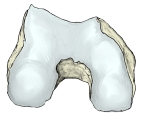 Right femur (inferior)
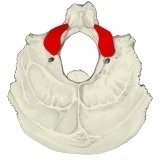 Occipital bone (inferior)
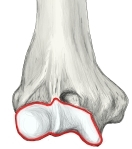 Condyle of humerus (anterior)
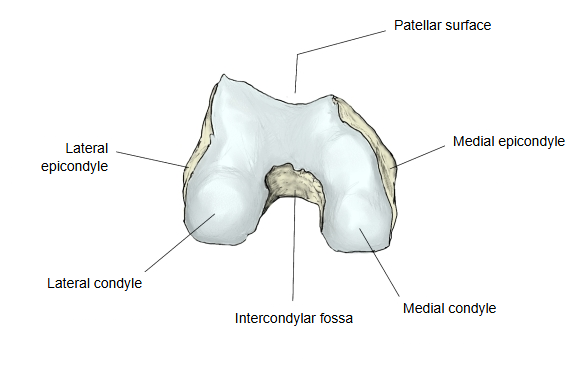
Related terms
- Articular surface
- Epicondyle
- Tubercle
- Tuberosity
- Medial condyle of femur
- Lateral condyle of femur
- Medial condyle of tibia
- Lateral condyle of tibia
- Occipital condyle
- Condyle of humerus
- Condylar process
References and sources
- Further reading: Condyle (anatomy), Wikipedia.
- Federative International Programme for Anatomical Terminology (FIPAT). Terminologia Anatomica, 2nd ed. (TA2), 2019.