Inferior articular surface of tibia (Latin: facies articularis inferior tibiae)
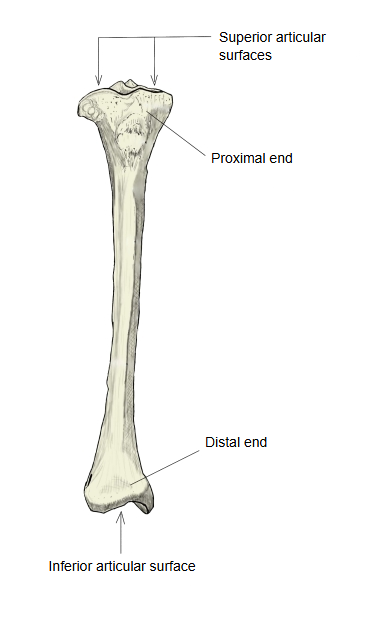
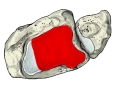
The joint surface on the underside of the lower end of the tibia, which rests on the talus; it is roughly four-sided (rectangular).
It is concave from front to back and slightly convex from side to side, because a low ridge running from front to back divides it into two shallow hollows. It is wider in front than behind. This matches the opposing surface of the talus, the trochlea, which is pulley-shaped and also wider in front.
surfaces of
the tibia
- Superior articular surface : the joint surfaces on top of the medial and lateral condyles → knee joint.
- Fibular articular facet : on the back and underside of the lateral condyle → tibiofibular joint.
- Inferior articular surface : on the underside of the lower end → talocrural (ankle) joint.
- Articular surface of medial malleolus : on the lateral side of the medial malleolus, continuous with the inferior articular surface → talocrural (ankle) joint.
It meets the upper surface of the trochlea of the talus at the talocrural (ankle) joint.
Medially it is continuous, at almost a right angle, with the articular surface of the medial malleolus; laterally it ends at the fibular notch, where the lower end of the fibula lies.
Reference websites
[Wikipedia]
· Tibia, Wikipedia.
· Ankle, Wikipedia.
[Websites with illustrations]
· Lower end of the tibia, posterior view (photograph) (Wikimedia Commons)

· Tibia: anatomy and clinical notes (Kenhub)
· The tibia: proximal, shaft and distal anatomy (TeachMeAnatomy)
Where it is found
Related terms
- Articular surface of medial malleolus
- Medial malleolus
- Distal epiphysis of tibia
- Fibular notch
- Superior articular surface of tibia
- Talocrural joint
- Talus