Sphenoidal concha (Latin: concha sphenoidalis)
Also called the sphenoidal turbinate, ossicle of Bertin
- Upper surface : faces the cranial cavity and forms the central part of the middle cranial fossa. Borders: ethmoid bone in front.
Features: tuberculum sellae, sella turcica with the hypophysial fossa and the dorsum sellae, middle and posterior clinoid processes, prechiasmatic sulcus, carotid sulcus, sphenoidal lingula. - Lower surface : forms part of the roof of the pharynx (the nasopharynx). Borders: vomer.
- Anterior surface : faces the nasal cavity. Borders: ethmoid bone.
Features: sphenoidal crest, sphenoidal rostrum, sphenoidal concha (aperture of the sphenoidal sinus). - Posterior surface : a rough, four-sided surface. Borders: occipital bone (basilar part).
· Some textbooks call only the anterior surface of the body of the sphenoid the sphenoidal concha; sources differ in how much they include.
· It develops as a separate small bone from the back part of the cartilage of the nasal capsule and fuses with the sphenoid (sometimes partly with the ethmoid bone) around puberty, so it is often described as originally part of the ethmoid.
Its two surfaces:
Upper surface: concave and facing the sphenoidal sinus. The plate forms most of the front wall and part of the floor of the sinus, and the aperture of the sphenoidal sinus opens through it.
Lower surface: convex; it forms part of the roof of the nasal cavity. The plate is broad in front and tapers to a point behind, where it lies above the vomer, between the root of the pterygoid process and the sphenoidal rostrum.
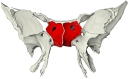 Sphenoidal concha
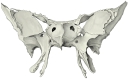 Sphenoid bone (anterior view)
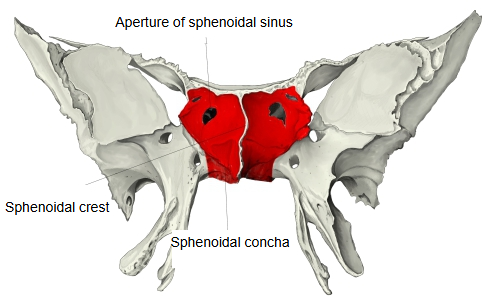
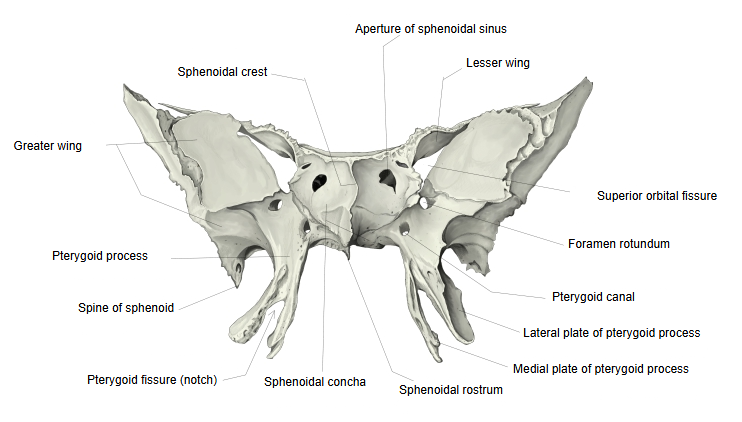
Reference websites
[Wikipedia]
· Sphenoidal conchae, Wikipedia.
· Sphenoid bone, Wikipedia.
[Websites with illustrations]
· Sphenoid bone, anterior and inferior surfaces (Gray's Anatomy) (Wikimedia Commons)

· Sphenoid bone, anterior view, with the sphenoidal concha (Jaypee Digital)

· Sphenoid bone: anatomy, function and development (Kenhub)
· Sphenoid bone (TeachMeAnatomy)
Related terms
- Spine of sphenoid
- Sphenoidal lingula
- Aperture of sphenoidal sinus
- Septum of sphenoidal sinuses
- Sphenoidal angle of parietal bone
- Middle clinoid process
- Body of sphenoid
- Sphenoidal sinus
- Sphenoid bone
- Sphenoethmoidal recess
- Nasal cavity
- Ethmoid bone
- Vomer
References and sources
- Further reading: Sphenoid bone, Wikipedia.
- Further reading: Sphenoidal conchae, Wikipedia.
- Federative International Programme for Anatomical Terminology (FIPAT). Terminologia Anatomica, 2nd ed. (TA2), 2019.