Bone marrow (Latin: medulla ossium)
- Overview (types (red and yellow marrow), composition)
- Reference websites
- (Wikipedia, websites with illustrations)
- Related terms
Overview
Spaces inside bones ⇒ the medullary cavity of long bones, and the gaps between the trabeculae of the spongy bone in flat bones and other bones.
· Auditory ossicles: the malleus, incus and stapes; very small and very dense.
· Pneumatic bones: bones that contain air, such as the sphenoid and the maxilla; much of their inside is taken up by the air spaces.
| Blood cell | Life span | Approx. number made per day | Notes | |
|---|---|---|---|---|
| 1 | Red blood cell | About 120 days | About 200 billion | Long-lived, but so numerous that the daily output is very large; production is steadier than that of white blood cells |
| 2 | Platelet | About 7-10 days | About 100 billion | Short-lived, so large numbers are replaced every day |
| 3 | Neutrophil | Hours to a few days | About 50-100 billion | Very short-lived, so their production in the marrow is very active |
| 4 | Monocyte / lymphocyte | Days to years | Far fewer; varies | Life span and rate of production differ with the type |
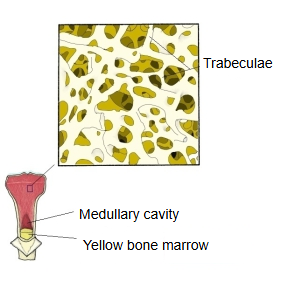
[Types (red and yellow marrow)]
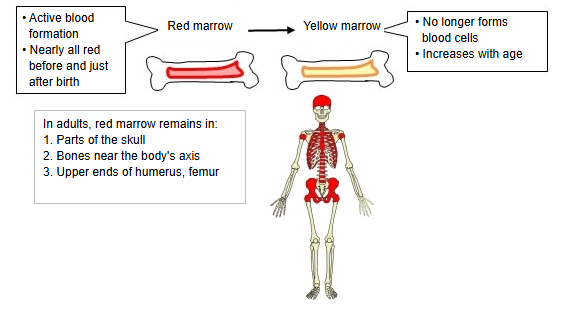
There are two kinds of bone marrow: red bone marrow, which forms blood and is red, and yellow bone marrow, which has turned to fat, no longer forms blood and is yellow.
After birth almost all the marrow is red marrow, but with age the share of yellow marrow gradually increases.
· Yellow marrow can turn back into red marrow when the body needs more blood cells, for example after severe blood loss.
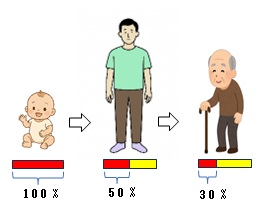
The amount of red marrow left at each age varies from person to person, so the percentages in the figure are only rough.
| 1 | Red bone marrow | red (bone) marrow (medulla ossium rubra) Marrow that is actively forming blood. In the fetus and newborn nearly all the marrow is red, but with age it is gradually replaced by yellow marrow. In adults red marrow remains in the following bones, which apart from the vertebrae are mostly flat bones: Trunk: sternum, vertebrae, ribs, hip bones Even in the femur and humerus, red marrow remains in adults in limited places such as the proximal ends. |
| 2 | Yellow bone marrow | yellow (bone) marrow (medulla ossium flava) Red marrow that has turned to fat and stopped forming blood. With age the marrow of the limb bones gradually loses its blood-forming function and becomes yellow marrow. |
[Composition]
| 1 | Blood-forming cells | blood cells Hematopoietic (blood) stem cells and blood cells at every stage of development. |
| 2 | Stromal cells | stromal cells Supporting cells of mesenchymal origin that hold and nourish the blood-forming cells. Some can become bone cells (osteocytes), cartilage cells (chondrocytes) or fat cells (adipocytes). |
| 3 | Fat | fat Fat cells are very few in the fetus and in infancy; their share increases steadily with age. |
| 4 | Blood sinusoids | sinusoids Thin-walled vessels through which new blood cells enter the circulation. |
Reference websites
[Wikipedia]
· Bone marrow, Wikipedia.
· Haematopoiesis, Wikipedia.
[Websites with illustrations]
· Bone marrow (Encyclopaedia Britannica)
· Bone marrow (with illustration) (National Cancer Institute)
Related terms
- Diaphysis
- Epiphysis
- Epiphyseal cartilage
- Periosteum
- Endosteum
- Bone matrix
- Cambium layer
- Flat bone
- Pneumatic bone
- Auditory ossicles
- Nutrient canal
- Spleen
- Thymus
- Lymph node
References and sources
- Further reading: Bone marrow, Wikipedia.
- Further reading: Haematopoiesis, Wikipedia.
- Federative International Programme for Anatomical Terminology (FIPAT). Terminologia Anatomica, 2nd ed. (TA2), 2019.