Visceral pelvic fascia (Latin: fascia pelvis visceralis)
Also called the visceral fascia of the pelvis (endopelvic fascia)
Overview
Fascia: once thought of as "the membrane that wraps a muscle", it is now generally understood as any sheet-like structure of connective tissue.
So the name is used even where no muscle is involved.
- Pelvic fascia : the subperitoneal fascia passes into it near the superior pelvic aperture.
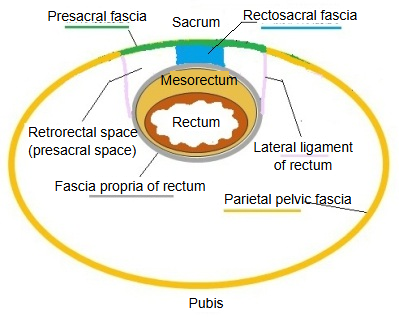
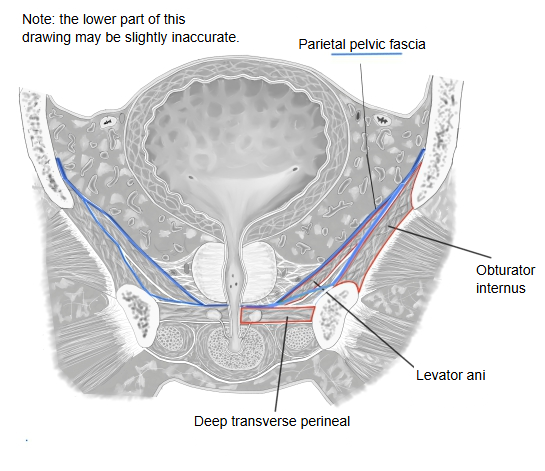
- Parietal pelvic fascia : "the fascia covering the muscles of the pelvic wall (obturator internus, piriformis and others) + the presacral fascia".
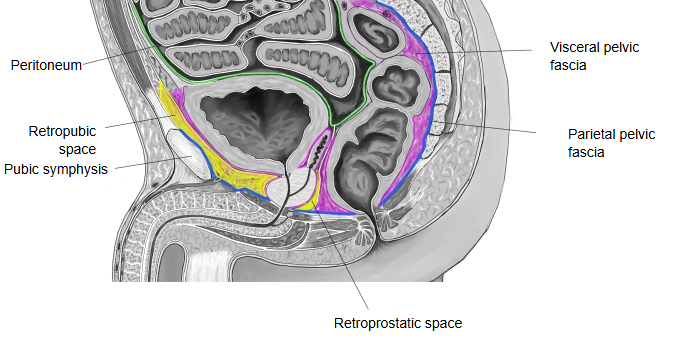
- Visceral pelvic fascia : forms the connective tissue on the surfaces of the pelvic organs and between them; a pathway for nerves and vessels. Its parts are named after the organs, e.g. the fascia propria of the rectum, the vesical fascia and the prostatic fascia.
inside the
pelvis
- Parietal pelvic fascia : "the fascia on the inner wall of the pelvis + the presacral fascia"; it fuses and blends with the surrounding periosteum and tendinous arches.
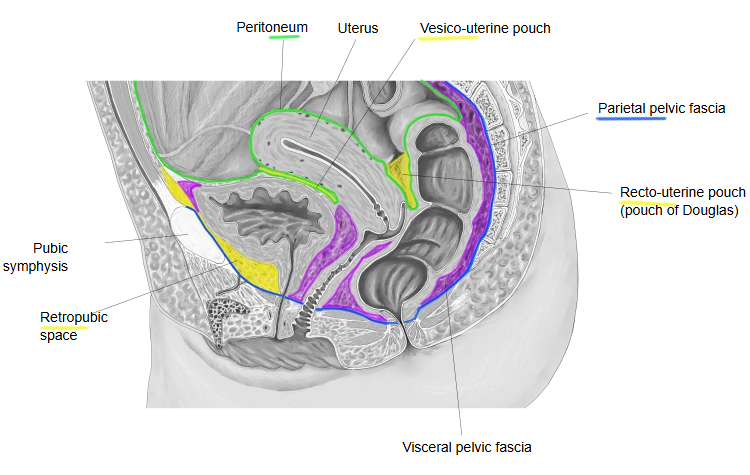
- Visceral pelvic fascia : covers the surfaces of the pelvic organs and fills the spaces between them (with fat and vessels, so it is thick). Its parts have their own names, such as the pubovesical ligament, the cardinal ligament and the rectovaginal septum.
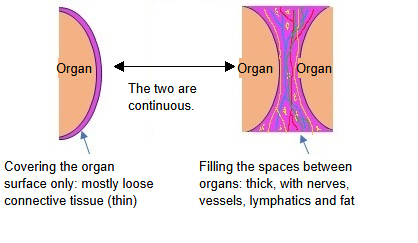
· It plays a very important part in holding the pelvic organs in their proper positions, and it is the pathway of their vessels and nerves. Over an organ surface it is thin and made mostly of loose connective tissue; between organs it is thick and contains fat, vessels, nerves and lymphatics. It meets the parietal pelvic fascia where the organs pass through the pelvic floor.
Thickened parts of the visceral pelvic fascia with their own names
The list below may not be complete.
| Part | Features described | |
|---|---|---|
| 1 | Lateral ligament of the rectum | where two layers of fascia meet; contains vessels and nerves. |
| 2 | Parametrium | thick fibrofatty tissue (adipose tissue) containing vessels, nerves and lymphatics; the part beside the cervix is called the paracervix. |
| 3 | Lateral ligament of the bladder | fibrofatty tissue containing vessels and nerves. |
| 4 | Rectovaginal septum | a fibrous, well-defined septum; the female counterpart of Denonvilliers' fascia (the rectoprostatic septum of the male). |
| 5 | Uterosacral ligament | a fibrous band containing nerve fibres. |
| Name | Notes | |
|---|---|---|
| 1 | Cardinal ligament (transverse cervical ligament, Mackenrodt's ligament) | cervix of the uterus ↔ side wall of the pelvis. It ties the uterus horizontally from both sides and helps prevent it from sinking down (uterine prolapse). The uterine artery runs through it. |
| 2 | Uterosacral ligament | back of the cervix ↔ sacrum. A strong band that passes on each side of the rectum and pulls the cervix backward; it helps keep the uterus anteverted in the middle of the pelvis and resists its descent. |
| 3 | Pubocervical ligament | back of the pubis ↔ under the bladder ↔ cervix. A continuous sheet of fascia that supports the uterus and bladder from the front like a hammock. When it slackens, a cystocele or uterine prolapse can result. |
| 4 | Pubovesical ligament | back of the pubis ↔ lower part (neck) of the bladder. A thickening of the fascia that fixes the outlet of the bladder firmly to the pubis in front; in males it corresponds to the puboprostatic ligament. |
| 5 | Lateral ligament of the rectum | side wall of the rectum ↔ side wall of the pelvis, around the inferior hypogastric plexus. A band of fascia that fixes the rectum from both sides; an important landmark that is always divided in operations that free the rectum (for example for cancer of the large intestine). |
Names by region
The parts of the visceral pelvic fascia that have their own names are listed below; the list may not be complete.
| Name | Notes | |
|---|---|---|
| 1 | Fascia propria of the rectum (mesorectal fascia) | The clearest membrane, enclosing the rectum and the mesorectum; the typical example of the visceral pelvic fascia. |
| 2 | Vesical fascia (see also the lateral ligament of the bladder) | Covers the part of the urinary bladder not covered by the peritoneum (the inferolateral surfaces and the base). Some sources count the lateral ligament of the bladder at its sides as visceral pelvic fascia. |
| 3 | Prostatic fascia | Encloses the whole prostate except where it meets the bladder. |
| 4 | Fascia of the seminal vesicles | Encloses the seminal vesicles and is continuous with the prostatic fascia. |
| 5 | Fascia of the uterus | Surrounds the cervix and the parts of the uterus not covered by peritoneum (the body is covered by the perimetrium); continuous with the fascia of the vagina. |
| 6 | Fascia of the vagina | Covers the surface of the vagina and is continuous with the fascia of the uterus. |
| 7 | Rectoprostatic (rectovesical) septum | = Denonvilliers' fascia; the partition between the rectum and the bladder and prostate in males (in females, the rectovaginal septum). |
Note: sources differ on which structures belong to the visceral pelvic fascia and on the names and limits of its thickenings.
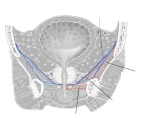 Bladder and pelvic floor (coronal section, male)
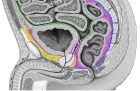 Male pelvis (median section)
 Female pelvis (median section)
Reference websites
[Wikipedia]
· Pelvic fascia, Wikipedia.
· Endopelvic fascia, Wikipedia.
Related terms
- Pelvic cavity
- Superior pelvic aperture
- Pelvic fascia
- Parietal pelvic fascia
- Subperitoneal fascia
- Mesorectum
- Fascia
- Rectum
- Urinary bladder
- Uterus
References and sources
- Further reading: Pelvic fascia, Wikipedia.
- Further reading: Endopelvic fascia, Wikipedia.
- Federative International Programme for Anatomical Terminology (FIPAT). Terminologia Anatomica, 2nd ed. (TA2), 2019.