Auricular tubercle (Latin: tuberculum auriculare)
Also called: Darwin's tubercle
It is a slight projection of the auricular cartilage on the posterosuperior part of the helix, where the rim of the auricle is folded forwards; it points forwards and slightly upwards and is easiest to see when the rim is folded over.
It is thought to correspond to the pointed tip of the ear of many other mammals, folded inwards in humans. It is inconstant, varies greatly in size and may be on one or both ears; it is a normal variant, not a disorder. It is named after Charles Robert Darwin (1809-1882), who described it.
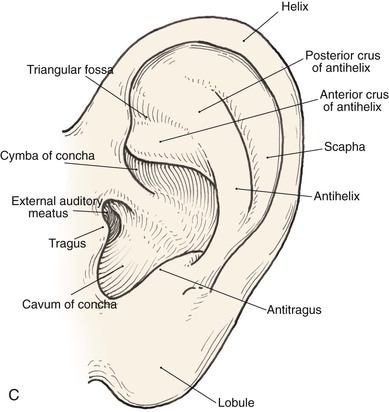
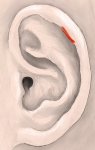 Left auricle (lateral surface)
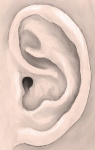 Left auricle (lateral surface)
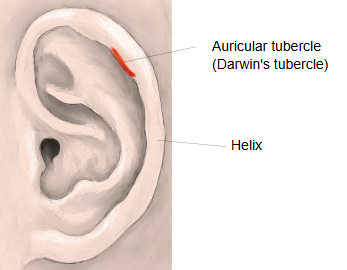
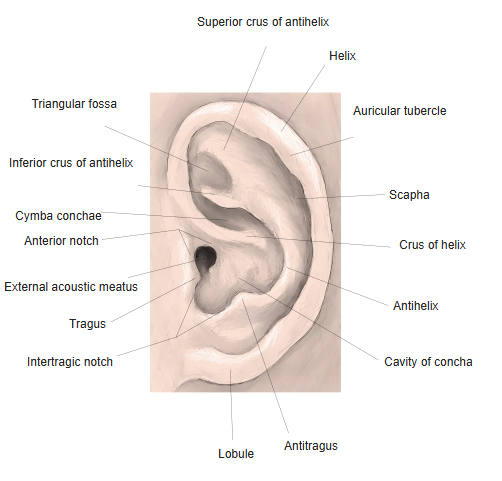
Names of the parts of the auricle
The surface of the auricle is full of ridges and hollows, and its parts have the following names.
Note: the antitragohelicine fissure can also be seen from the lateral surface.
Reference websites
[Wikipedia]
· Darwin's tubercle, Wikipedia.
· Auricle (anatomy), Wikipedia.
[Websites with illustrations]
· Photograph of the auricle with its parts labelled (Gray's Anatomy for Students) (Pinterest (image))

· Drawing of the auricle with its parts labelled (pocketdentistry.com)
· The auricle, lateral surface (Gray's Anatomy, fig. 904) (Wikimedia Commons)

Related terms
- Auricular muscles
- Auricular cartilage
- Auricular region
- Concha of auricle
- Auricle
- External ear
- Anterior notch of auricle
- Extrinsic auricular muscles
- External acoustic meatus
References and sources
- Further reading: Darwin's tubercle, Wikipedia.
- Federative International Programme for Anatomical Terminology (FIPAT). Terminologia Anatomica, 2nd ed. (TA2), 2019.