Fascia propria of rectum (Latin: fascia propria recti)
Also called the mesorectal fascia or the rectal fascia
Overview
Fascia: once understood as "the membrane that wraps a muscle", it is now regarded as any membrane-like sheet of connective tissue.
So a sheet may be called a "fascia" even when it has nothing to do with muscle.
- Fascia inside the pelvis : continues from the subperitoneal fascia near the pelvic inlet; also called the pelvic fascia.
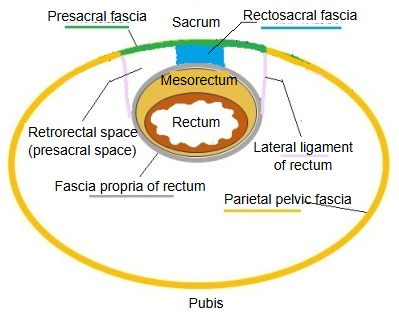
- Parietal pelvic fascia : the fascia covering the pelvic wall (obturator internus, piriformis and others) + the presacral fascia.
- Visceral pelvic fascia : covers the surfaces of the pelvic organs and forms the connective tissue between them, a pathway for nerves and vessels. Its parts take the names of their organs, e.g. the fascia propria of the rectum, the vesical fascia and the prostatic fascia.
In front the mesorectum is very thin (in places absent), so the fascia lies close to the rectal wall; behind, it stands well away from the rectum, enclosing the thick mesorectum.
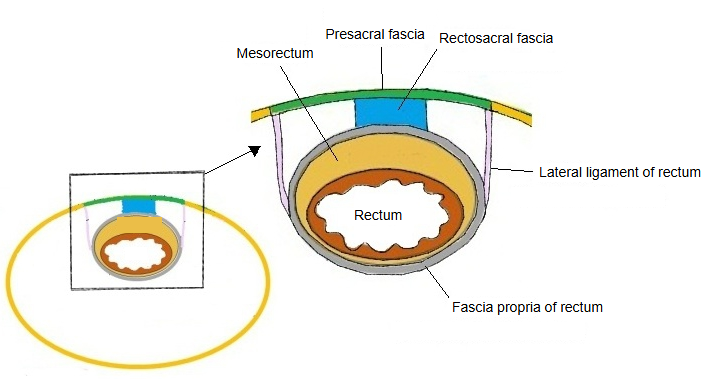
| Layer | Description |
|---|---|
| Sacrum | Covered on its surface by periosteum. |
| Presacral fascia | A layer of dense fibrous tissue covering the front of the sacrum and coccyx; part of the parietal pelvic fascia. |
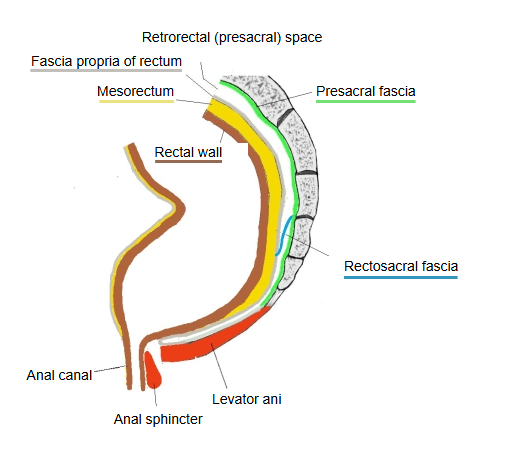
| Retrorectal space / presacral space | Loose tissue. Sources differ on the names and limits: some treat the two spaces separately, others as the same space, and the boundary between them is not clear. The rectosacral fascia crosses this space from the presacral fascia to the fascia propria and divides it into upper and lower parts. |
| Fascia propria of the rectum | The fascia that encloses the mesorectum. |
| Mesorectum | Fat containing vessels and lymph nodes that covers almost the whole circumference of the rectum (especially behind it); about 5 mm to 3 cm thick, depending on the amount of fat. |
| Rectum | Its upper part continues from the sigmoid colon; there (the rectosigmoid part) the rectum is covered by visceral peritoneum. |
Clinical significance
· Behind it lies the retrorectal space, which separates it from the presacral fascia on the front of the sacrum.
· In total mesorectal excision (TME) for rectal cancer, the rectum is removed inside an intact fascia propria, together with the whole mesorectum and its lymph nodes.
· In MRI staging of rectal cancer, the distance from the tumour to this fascia (the circumferential resection margin) is an important finding.
Reference websites
[Wikipedia]
· Total mesorectal excision, Wikipedia.
· Pelvic fascia, Wikipedia.
[Websites with illustrations]
· Fasciae and spaces around the rectum (median section) (Springer)

· Rectum, mesorectum and fascia propria (cross-section) (Springer)

· Fascia propria, rectosacral and presacral fasciae (Obgyn Key)

Related terms
- Retrorectal space
- Rectosacral fascia
- Transverse folds of rectum
- Rectococcygeus
- Mesorectum
- Rectum
- Visceral pelvic fascia
- Presacral fascia
- Presacral space
- Parietal pelvic fascia
- Pelvic fascia
References and sources
- Further reading: Total mesorectal excision, Wikipedia.
- Further reading: Pelvic fascia, Wikipedia.
- Federative International Programme for Anatomical Terminology (FIPAT). Terminologia Anatomica, 2nd ed. (TA2), 2019.