Langerhans cell
· The name comes from its discoverer, the German Paul Langerhans (1868), but the cell has nothing to do with the islets of Langerhans of the pancreas.
cells of the
epidermis
- Keratinocytes : about 90% of the cells. They divide actively and some move up into the upper layers; also called keratinising cells.
- Melanocytes : lie in the stratum basale and produce melanin (pigment).
- Merkel cells : many in highly sensitive areas such as the fingertips; connected to afferent (sensory) nerve fibres.
- Langerhans cells : dendritic cells of the immune system in the stratum spinosum; about 2–5%.
- Dendritic cells : Langerhans cells, myeloid dendritic cells, plasmacytoid dendritic cells and others.
- Granulocytes
- Monocytes : develop into macrophages.
- Lymphocytes
- B cells : develop into plasma cells.
- NK cells
- T cells
It is one of the white blood cells and an antigen-presenting cell. It comes from the bone marrow; in sections it is a pale cell, and the electron microscope shows rod-shaped Birbeck granules in its cytoplasm.
Function
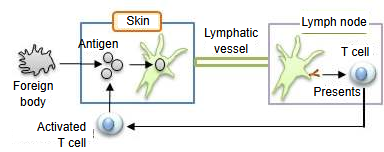
Langerhans cells can move. When an antigen enters through the skin, they take it in with their branching processes, travel through the lymph vessels to a regional lymph node, and there present the antigen to T cells and activate them.
The activated T cells travel to the skin and release cytokines to deal with the foreign material; this reaction can cause inflammation.
Reference websites
[Wikipedia]
· Langerhans cell, Wikipedia.
[Websites with illustrations]
· Dendritic (Langerhans) cells in the skin, light micrograph (Wikimedia Commons)

· Langerhans cells (images) (Wikimedia Commons)
Related terms
- Dendritic cell
- Epidermis
- Stratum spinosum
- Keratinocyte
- Skin
- Lymph node
- White blood cell
- Islets of Langerhans
References and sources
- Further reading: Langerhans cell, Wikipedia.
- Federative International Programme for Anatomical Terminology (FIPAT). Terminologia Anatomica, 2nd ed. (TA2), 2019.