Eleventh rib (Latin: costa XI)
The main features of the eleventh rib are as follows.
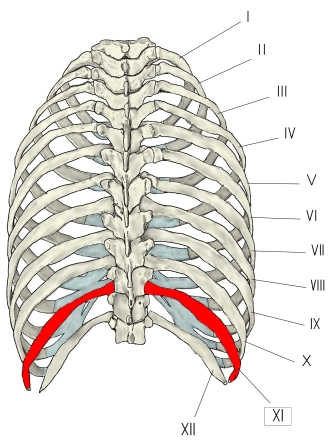
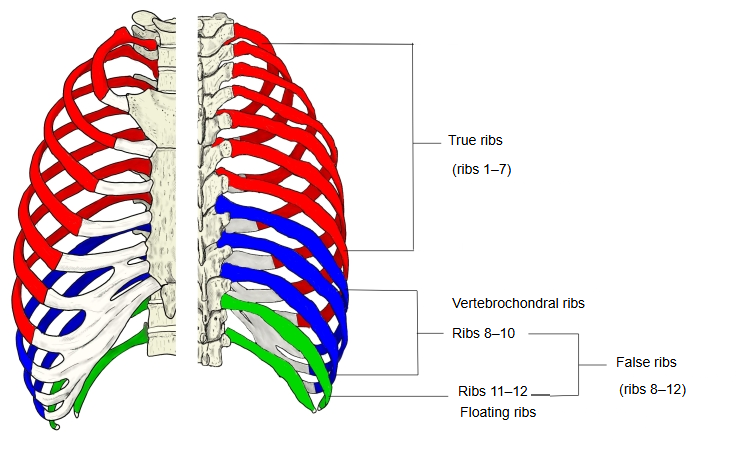
The ribs are divided into true ribs and false ribs; the eleventh rib is the second from the bottom of the five false ribs. Its back end articulates with the eleventh thoracic vertebra, but its front end, tipped with a short piece of cartilage, does not reach the costal cartilage above or the sternum and ends free among the muscles of the abdominal wall. For this reason it is called a floating rib.
- True ribs : first to seventh ribs.
- False ribs
- Vertebrochondral ribs : eighth, ninth and tenth ribs.
- Floating ribs : eleventh rib and twelfth rib.
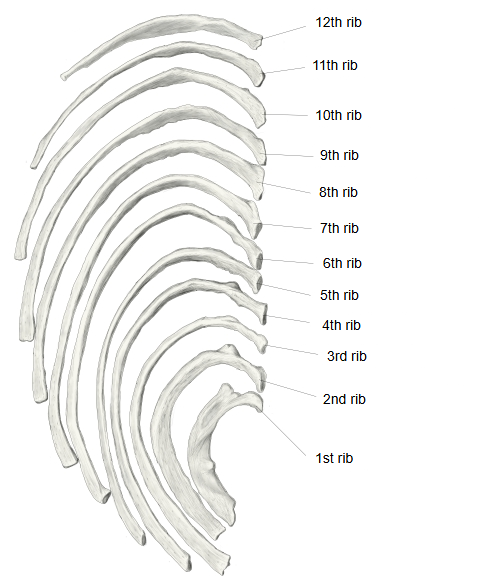
Of the 12 pairs of ribs, the third to tenth have the typical rib shape; the others, listed below, do not. The eleventh rib is one of them (some sources also count the tenth rib as atypical).
the typical shape
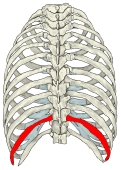 Thorax (posterior view)
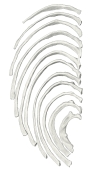 Right ribs 1-12 (superior view)
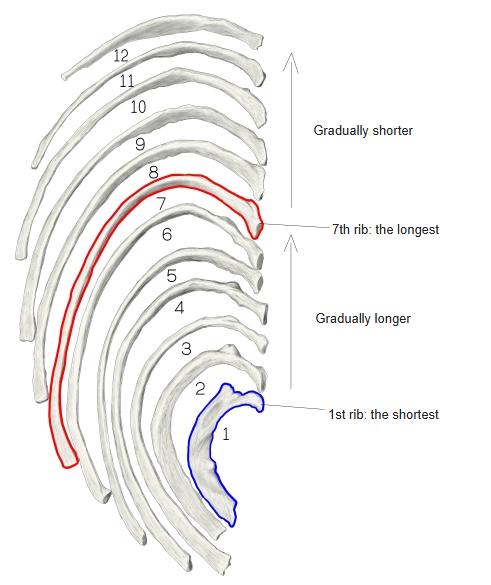
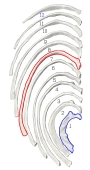 Lengths of the ribs
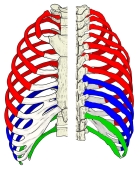 True and false ribs
Attachments
The muscles and ligaments attached to the eleventh rib are listed below; the list may not be complete. Ligaments are divided into those attached to the bony part of the rib (costal bone) and those attached to the costal cartilage; whether ligaments of the costal cartilage should count as ligaments of the rib is open to debate.
| Name | Attachment | |||
|---|---|---|---|---|
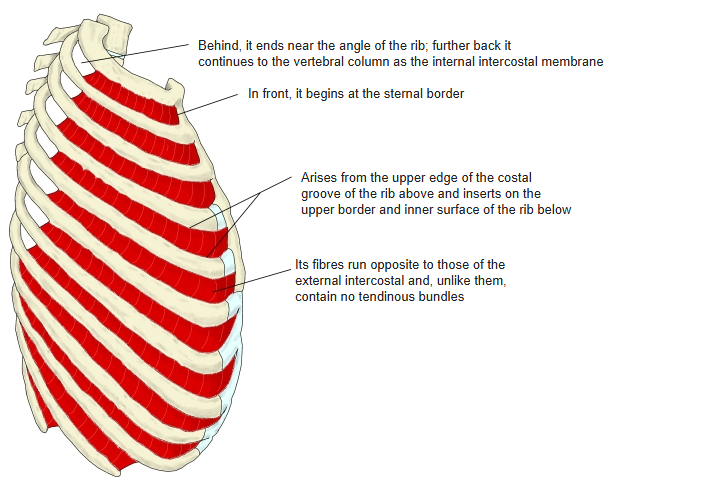
| Muscles | Origin | 1 | Internal intercostal muscle | all ribs: from the upper margin of the costal groove to the upper border of the body of the rib below |
| 2 | External intercostal muscles | all ribs: from the lower border of the outer surface to the upper border of the outer surface of the rib below | ||
| 3 | Innermost intercostal muscle | not always present | ||
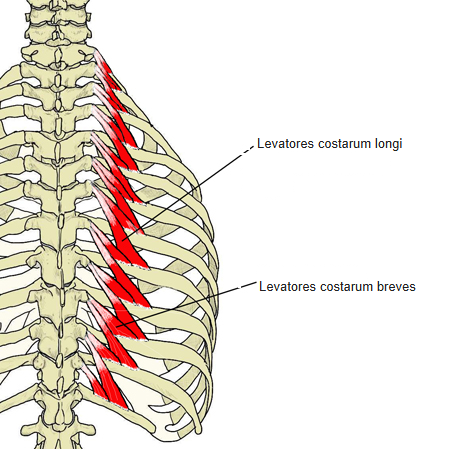
| Insertion | 1 | Levatores costarum | upper border of the rib between the tubercle region and the angle ⇔ transverse processes of C7-T11 (thoracic vertebrae) | |
| Ligaments | Bony rib | 1 | Radiate ligament of head of rib | head of rib ⇔ vertebral body and intervertebral disc |
| 2 | Costotransverse ligament | neck of rib ⇔ transverse process (rudimentary or absent on this rib) | ||
| 3 | Superior costotransverse ligament | neck of rib ⇔ transverse process of the vertebra above | ||
| 4 | Lateral costotransverse ligament | tubercle region ⇔ transverse process (rudimentary or absent on this rib) |
· Other muscles attached to the eleventh rib include latissimus dorsi, serratus posterior inferior, the external oblique, the internal oblique, transversus abdominis and the diaphragm.
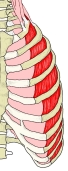 External intercostal muscles
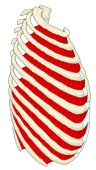 Internal intercostal muscles
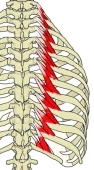 Levatores costarum
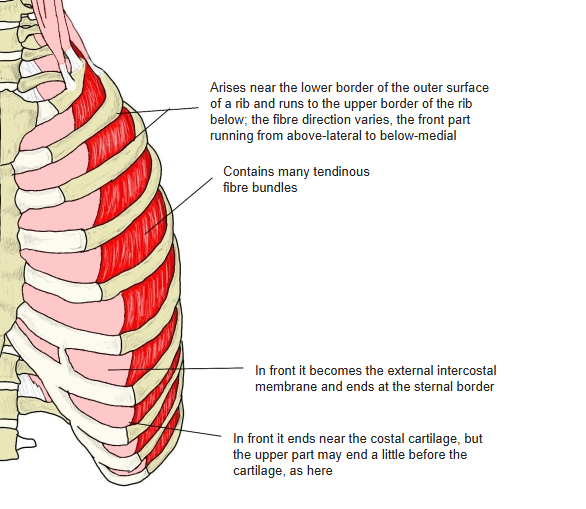
Reference websites
[Wikipedia]
· Rib, Wikipedia.
· Rib cage, Wikipedia.
[Websites with illustrations]
· Ribs: anatomy, ligaments and clinical notes (Kenhub)
· The ribs (typical and atypical ribs) (TeachMeAnatomy)