Acquired immunity
adaptive immunity
Overview
system
- Innate immunity : inborn; the first to respond to a foreign agent.
Made up of: monocytes, macrophages, dendritic cells, natural killer cells, granulocytes, complement and others. - Acquired immunity : acquired after birth; it learns and remembers the features of a foreign agent that has once entered the body, and is ready for the next entry.
Made up of: B cells (which become plasma cells and produce antibodies) and T cells (cell-mediated immunity).
Components
Acquired immunity has three parts: cell-mediated immunity, carried out by T cells; humoral immunity, carried out by B cells; and the other cells that support them (dendritic cells and macrophages).
immune
system
- T cells (cell-mediated immunity)
- Helper T cells : are activated by antigen presentation and direct other cells to attack.
- Killer T cells : attack virus-infected cells and cancer cells directly.
- Regulatory T cells : keep the immune response from becoming excessive.
- B cells (humoral immunity)
- Plasma cells : are found in the secondary lymphoid organs and the bone marrow and produce large amounts of antibodies.
- Memory B cells : live long in the body and respond quickly when the same antigen is met again.
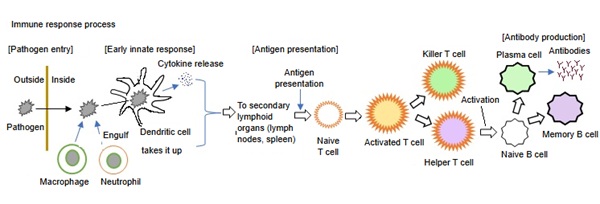
How the immune response proceeds
1. 1. Entry of a pathogen
Bacteria, viruses or other pathogens cross the barrier of the skin or mucous membranes and enter the body.
2. 2. Early response of innate immunity
Macrophages and neutrophils engulf the pathogen.
Dendritic cells take up the pathogen and prepare for antigen presentation. Inflammation occurs, and cytokines and chemokines are released.
3. 3. Antigen presentation
Dendritic cells take up the antigen of the pathogen and move to the secondary lymphoid organs (lymph nodes and the spleen).
There they present the antigen to T cells so that the T cells recognize it.
4. 4. Activation of T cells
Helper T cells (CD4+): activate B cells and other immune cells.
Killer T cells (CD8+): prepare to attack infected cells directly.
5. 5. Activation of B cells
B cells that have recognized the antigen are activated with the help of helper T cells. They divide and differentiate into plasma cells and memory B cells.
6. 6. Antibody production
Plasma cells make large amounts of antibodies and release them into the blood and lymph. The antibodies neutralize the pathogen or mark it so that other immune cells attack it.
7. 7. Formation of immune memory
Memory B cells and memory T cells remain and respond quickly to later infections by the same pathogen.
Reference websites
[Wikipedia]
· Adaptive immune system, Wikipedia.
Related terms
References and sources
- Further reading: Adaptive immune system, Wikipedia.
- Federative International Programme for Anatomical Terminology (FIPAT). Terminologia Anatomica, 2nd ed. (TA2), 2019.