Intercarpal joints (Latin: articulationes intercarpales)
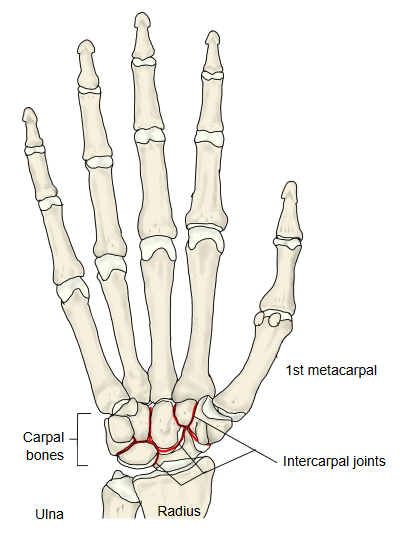
The intercarpal joints are the joints between the carpal bones, leaving out the pisiform. The joint between the proximal row and the distal row of carpal bones is called the midcarpal joint.
| ⇐ Thumb side | Little-finger side ⇒ | |||
|---|---|---|---|---|
| Distal row | Trapezium | Trapezoid | Capitate | Hamate |
| Proximal row | Scaphoid | Lunate | Triquetrum | Pisiform |
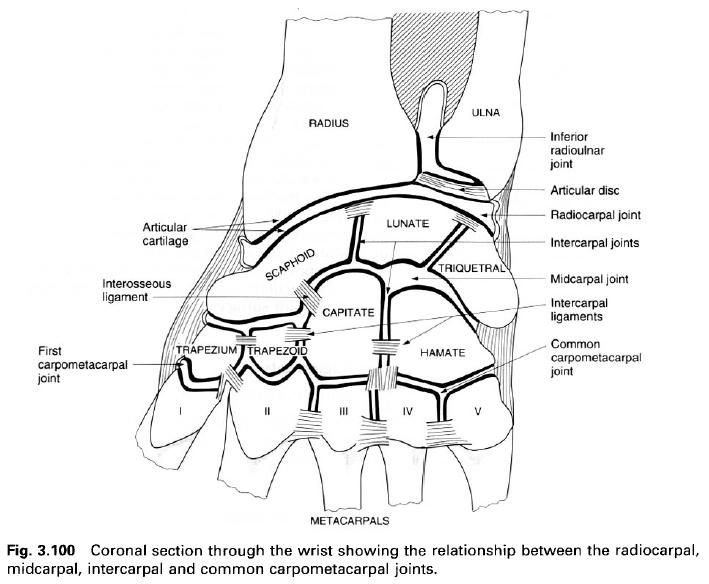
The joints between neighbouring bones within each row are the intercarpal joints in the narrow sense; the S-shaped joint between the two rows is the midcarpal joint. The pisiform has its own pisiform joint with the triquetrum. Sources differ on whether the midcarpal joint is counted among the intercarpal joints or listed separately.
Within the rows the bones are held by interosseous, palmar and dorsal intercarpal ligaments; the distal row moves almost as one unit. The midcarpal joint moves together with the radiocarpal joint and is reinforced by the radiate carpal ligament. Movement at each joint is small, but together they add to the movements of the wrist.
More detail
Type of joint
One source describes them as follows:
The carpal bones are joined by ligaments, and their joint cavities communicate with each other. All of them are plane joints that allow only slight gliding movements.
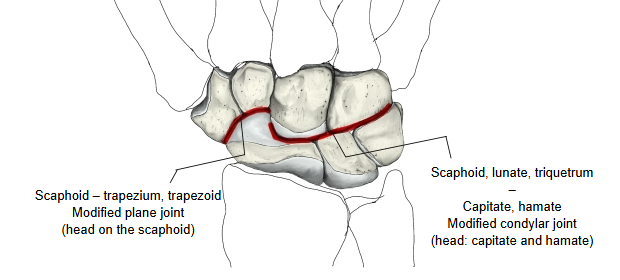
Another source describes them in more detail:
In the lateral part, between the scaphoid and the trapezium and trapezoid, the distal part of the scaphoid forms the articular head: a modified plane joint. In the medial part, between the scaphoid, lunate and triquetrum and the capitate and hamate, the distal capitate and hamate form the articular head: a modified condylar joint that takes part in flexion, extension, abduction and adduction of the hand. The joints between the bones within the proximal row and within the distal row are amphiarthroses. The articular capsules are short (especially on the palmar side) with many synovial folds, and the joint cavities communicate with each other. All movements of the intercarpal joints are markedly limited.
In any case, the following can be said:
Some sources describe the midcarpal joint as follows:
In form, its proximal side is the articular surface of the proximal carpal row, made mainly by the scaphoid and lunate; this surface forms the socket. Into it fits the distal carpal row, whose articular head is formed around the proximal head of the capitate. The proximal row has much play (which allows movement) and forms a flexible socket, while the distal row works as one firmer unit and forms the head of the joint.
Reference websites
[Wikipedia]
· Intercarpal joints, Wikipedia.
[Websites with illustrations]
· Coronal section through the wrist with the radiocarpal, midcarpal and intercarpal joints (Photobucket (image))
Where it is found
Related terms
- Midcarpal joint
- Radiocarpal joint
- Pisiform joint
- Proximal carpal row
- Distal carpal row
- Carpal bones
- Carpometacarpal joints
References and sources
- Further reading: Intercarpal joints, Wikipedia.
- Federative International Programme for Anatomical Terminology (FIPAT). Terminologia Anatomica, 2nd ed. (TA2), 2019.