Natural killer T cell
Also called NKT cell
The natural killer T cell (NKT cell) is a kind of lymphocyte that protects the body by attacking bacteria and viruses that have entered it, and tumour cells.
- Dendritic cells
- Granulocytes
- Monocytes : become macrophages
- Lymphocytes
- B cells : become plasma cells
- NK cells
- T cells : helper T cells, killer T cells, NKT cells and others
More details
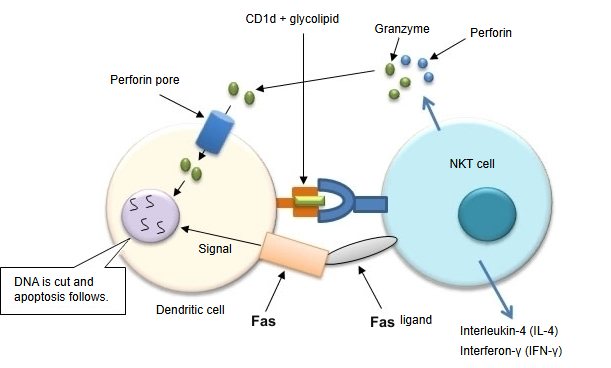
NKT cells are granular lymphocytes that share features of both natural killer (NK) cells and T cells: they are a small group of T cells that also carry receptors typical of NK cells. Unlike ordinary T cells, they recognise lipid antigens (glycolipids) rather than peptides, and they respond within hours. They link innate and adaptive immunity: once activated, they release cytokines that steer other immune cells, and they can kill target cells directly.
· Most develop in the thymus, but development outside the thymus has also been described, in the bone marrow, the liver and the gastrointestinal tract.
· They are most common in the liver and bone marrow and few in the peripheral blood, lymph nodes, spleen and thymus. In mice they have been reported to make up about 0.4% of the lymphocytes of the thymus, about 25% of those of the liver and bone marrow, and 1-2% of those of the spleen; humans have far fewer (sources differ).
· Like NK cells (and killer T cells), they express Fas ligand, which binds Fas on the target cell, and release perforin and granzymes; both routes damage tumour cells and other targets and lead to their apoptosis.
· Unlike killer T cells, they are reported not to be suppressed by radiation, anticancer drugs or steroid drugs.
Cytokines they produce
· Interleukin-4 (IL-4): favours Th2 (antibody-related) responses.
· Interferon-gamma (IFN-γ): favours Th1 (cell-mediated) responses.
Receptors
NKT cells have the following three kinds of receptor.
| 1 | Antigen receptor (T-cell receptor) | In the classical (invariant) type it has an almost fixed structure (Vα14/Vβ8 in mice, Vα24 in humans). It recognises a glycolipid, such as α-galactosylceramide (α-GalCer), held by CD1d, an MHC class I-like (class Ib) molecule on antigen-presenting cells such as dendritic cells, and the cell is then activated. |
| 2 | NK cell receptor | NK1.1 / CD161 |
| 3 | Inhibitory receptor | receptors for MHC class I molecules |
Co-stimulatory pairs
· Between NKT cells and dendritic cells there is a CD28/B7 co-stimulatory pair.
· Between dendritic cells and NKT cells there is also a CD40/CD154 (CD40 ligand) co-stimulatory pair; these pairs reinforce the contact between the two cells.
Related terms
References and sources
- Further reading: Natural killer T cell, Wikipedia.
- Federative International Programme for Anatomical Terminology (FIPAT). Terminologia Anatomica, 2nd ed. (TA2), 2019.