Parietal notch (Latin: incisura parietalis ossis temporalis)
· It marks the back end of the line along which the squamous part and the petrous part (its mastoid part) are fused by bone.
- Squamous part : occupies the middle and the whole upper part of the bone; it has two surfaces, temporal and cerebral.
- Petrous part
- Mastoid part : below the squamous part, from the mastoid process up to the parietal notch.Related terms: mastoid process, mastoid notch, groove for occipital artery, groove for sigmoid sinus, mastoid foramen, occipital border, stylomastoid foramen, canaliculus for chorda tympani, petrotympanic fissure
- Pyramid : a three-sided pyramid running forwards and medially from the boundary of the squamous and mastoid parts, with three surfaces and three borders: the petrous part in the narrow sense.
- Tympanic part : the smallest part: a thin, half-tube-shaped plate that forms the front and lower walls of the external acoustic meatus.
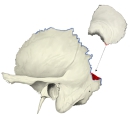 Left temporal and parietal bones
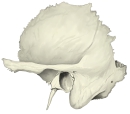 Temporal bone (lateral view), labelled
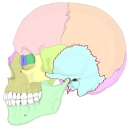 Skull (lateral view), bones coloured
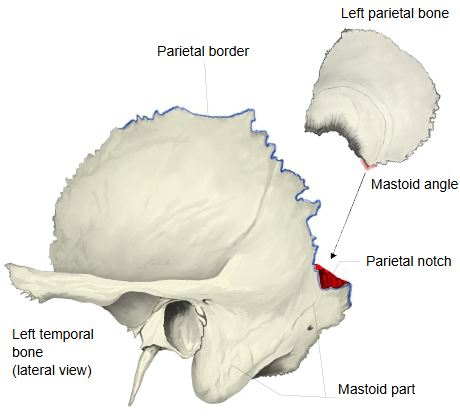
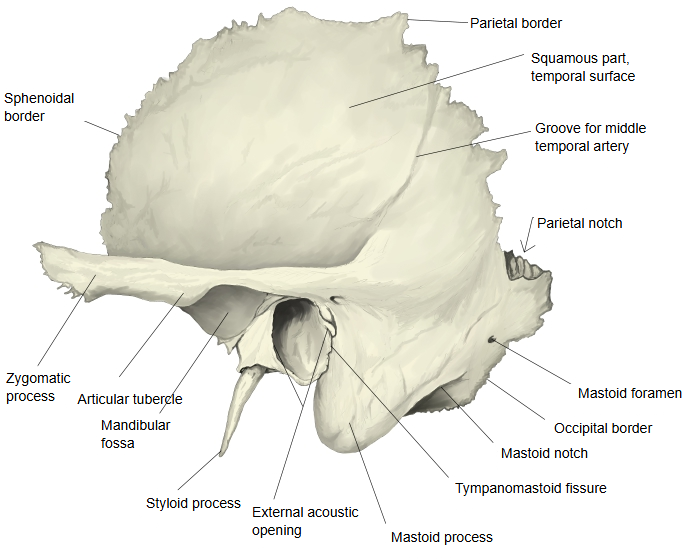
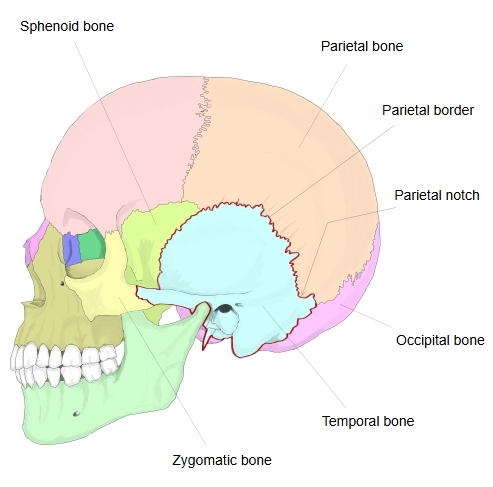
At the back, the superior border of the squamous part meets the mastoid part at an angle: this angle is the parietal notch. In front of the notch the border of the squamous part overlaps the parietal bone at the squamous suture (the squamosal border of the parietal bone); behind it the mastoid part meets the parietal bone at the parietomastoid suture, which continues backwards into the occipitomastoid suture.
Reference websites
[Wikipedia]
· Temporal bone, Wikipedia.
[Websites with illustrations]
· The temporal bone (TeachMeAnatomy)
· Temporal bone: anatomy, parts, sutures and foramina (Kenhub)
· Left temporal bone, outer surface (Gray's Anatomy, fig. 137) (Wikimedia Commons)

Related terms
- Temporal bone
- Parietal bone
- Squamous part
- Petrous part
- Mastoid process
- Squamosal border
- Occipitomastoid suture
References and sources
- Further reading: Temporal bone, Wikipedia.
- Federative International Programme for Anatomical Terminology (FIPAT). Terminologia Anatomica, 2nd ed. (TA2), 2019.